
Boom mowers are among the most frequently confused concepts in the entire road-maintenance, municipal and agricultural machinery sector. The same name is often applied to two completely different designs that differ not only in construction, but above all in legal status. For the user — a road authority, a municipality, a green-space maintenance contractor or a farmer — this distinction is not an academic nuance. It determines whether, in the event of an inspection, an accident or compensation proceedings, the machine turns out to be “paperwork-safe” or becomes the source of a very real problem.
The following material sorts out the terminology, describes the construction and the types of working heads, and then shows what to look at before ordering such a machine at all. The point of reference is the legal situation in force in the European Union and in Poland, not the slogans from sales brochures.
Boom mowers — what really lies behind a single name
Several names are in circulation describing what appears to be the same device: boom mower, mower on a boom, flail mower on a boom, and in everyday speech simply “an arm for mowing verges”. From a marketing point of view these are synonyms. From a legal point of view — not necessarily.
Under these names we encounter, in practice, three different design solutions:
- A hydraulic arm + a separate working head — two distinct machines, deliberately kept apart, so that a single arm can be used with different tools. This is the model found, among others, at Polish and British manufacturers.
- An integrated machine with a single rating plate — the arm and one mowing head form a single, inseparable product. This is the solution typical of some Italian machines, described on the rating plate as trinciatrice laterale, i.e. a side flail mower.
- The arm as partly completed machinery — a carrier that performs no working function on its own and only becomes a complete machine once combined with a head.
Each of these variants means a different set of documents, a different scope of liability and different expansion possibilities. The trade name does not settle this.
What a given machine is is decided not by the name on the rating plate or in the brochure, but by the content of the declaration of conformity and the technical documentation.
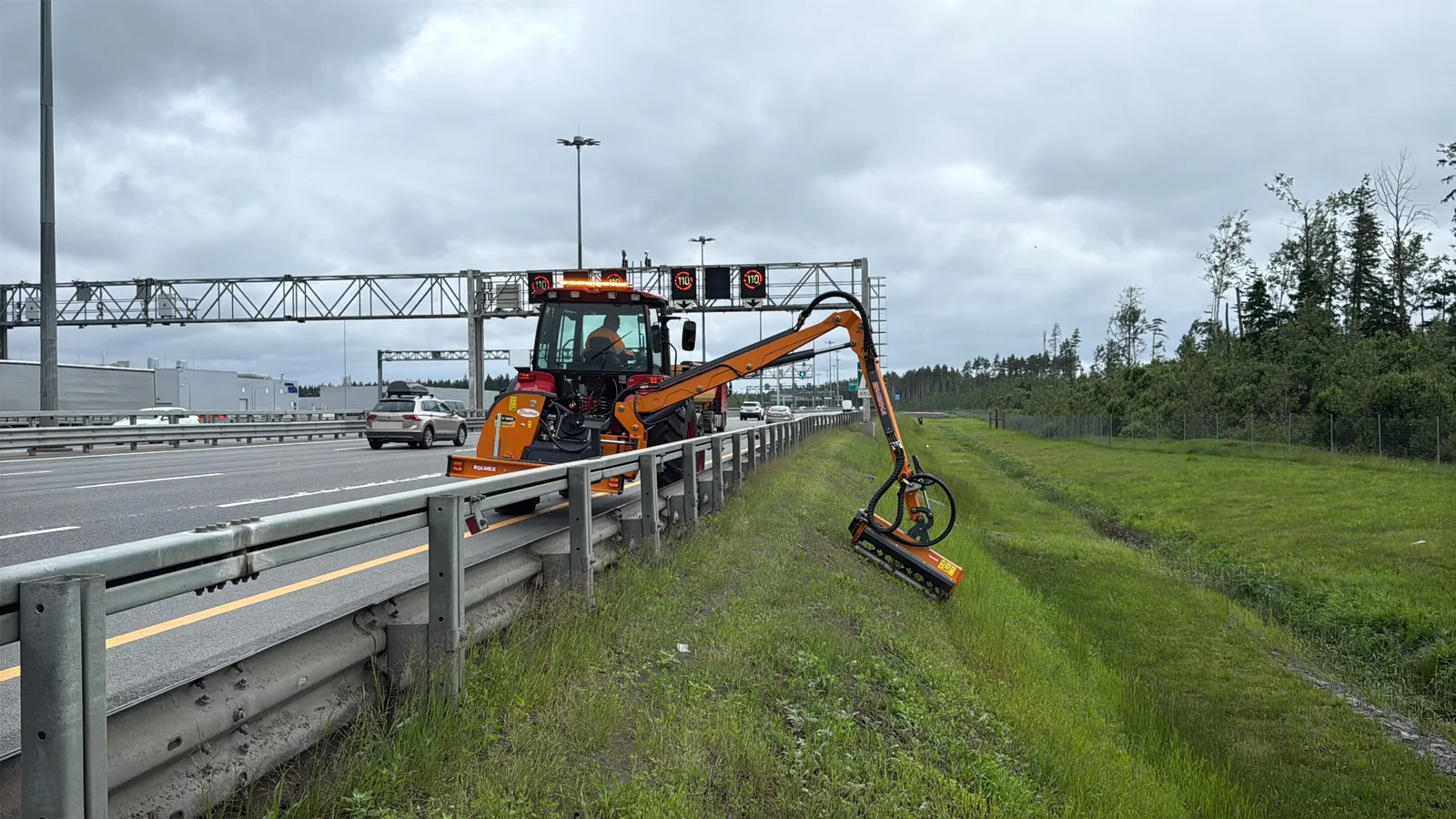
The construction of a boom mower — arm, head, hydraulics
Although the designs differ in detail, every boom mower rests on the same functional assemblies.
The arm (boom)
The arm is a system of articulated members moved by hydraulic cylinders. It usually comprises: a base with a slewing ring (mounted to the carrier), a lift arm, a reach arm (the so-called “elbow”), and in many solutions an additional telescopic member increasing the reach. The geometry of the members determines how far and how high the machine reaches and how it positions the tool relative to a bank, a ditch or a hedge.
The hydraulic system
The movements of the arm and the drive of the head are provided by the hydraulic system. The pump is most often supplied by the carrier’s power take-off (PTO) or by a separate drive system. The oil pressure and flow delivered by this system determine the power available to the tool — which is why the choice of head must always match the capacity of the specific arm.
Break-back protection
A key safety element is the break-back (non-stop) safety device — a mechanism which, when the head strikes an obstacle (a post, a stone, a barrier), allows the arm to swing away and return to the working position, limiting damage and risk. This is one of the features that are sometimes expressly required in tender proceedings.
Method of mounting on the carrier
Boom mowers are mounted in various ways: at the rear of the tractor (on a three-point linkage), at the front, to the side, and also on special carriers or construction machines. The mounting method affects the stability of the combination, visibility of the tool and mass distribution — and therefore also how the machine behaves during transport.
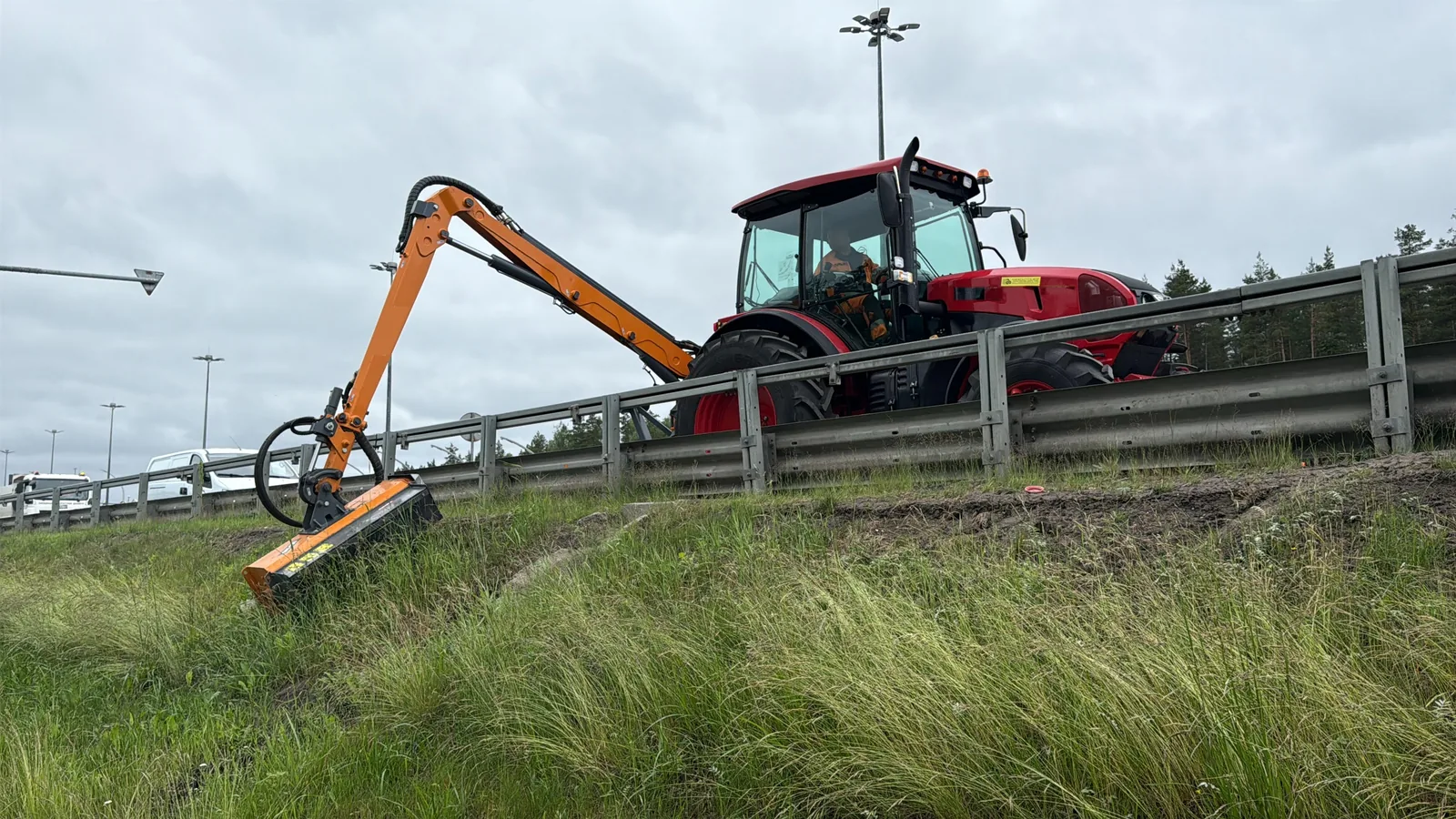
A hydraulic arm is not yet a mower
The most important distinction is simple: the hydraulic arm is a carrier of power and reach, while the working head is the tool that converts this power into a specific task. The arm delivers oil flow, pressure and reach; the head decides what the machine actually does.
In English terminology this division is directly visible. The carrier is called a power arm — literally an “arm of power”, i.e. the element providing power. The cutting tool is a flail head — a flail working head. These are two physically and formally separate machines, not one product. The same logic applies to Polish designs.
The separation of arm and head is no accident — it is a deliberate design feature. Thanks to it, a single arm can be used with different working heads: a flail mower, a branch shear, a circular saw, a stump cutter, a forestry mulcher, a verge cutter, and even heads that have nothing to do with mowing. One example of this direction of development is hydraulically driven power generators connected to the arm — a sign that the “arm” long ago ceased to be solely the drive of a mower and now serves as a universal tool carrier.
And here lies the heart of the problem. If a machine is sold as a complete boom mower with a single rating plate — that is, as one product in which the head is permanently assigned to the arm — then formally a different head cannot be fitted to that arm. The manufacturer did not envisage such a change, did not cover it with a risk assessment and did not describe it in the documentation. Italian manufacturers of trinciatrice laterale-type machines often attach no importance to this, because from their perspective they are selling a finished mower, not a tool platform.
Working heads — from the flail head to the saw and the cutter
The value of the arm as a carrier only becomes apparent when we look at the range of working heads that can operate on it. The most common are:
- Flail head (mulching head) — the basic tool for mowing grasses, weeds, self-seeded plants and light brush; it shreds the material on the spot.
- Branch and brush shear — for cutting woody shoots and branches, including hedge shaping and maintaining the road clearance profile.
- Circular saw — for cutting thicker boughs and pruning trees; the most demanding and most dangerous of the heads (see separate section).
- Stump cutter / grubber — for removing stumps and root stocks after felling.
- Forestry mulcher — for shredding brush and trees together with the wood, in clearance work and site preparation.
- Verge cutter / verge trimmer — for profiling and lowering road verges.
- Ditch cleaner, weed remover — for work related to drainage and ditch maintenance.
- Special heads — including brushes/sweepers, ploughs, augers, and also hydraulic power generators as a power-supplying tool.
From a legal point of view each of these heads is usually a separate product — with its own risk assessment, documentation and declaration. That is why “an arm with a set of heads” and “a complete mower” are two different formal situations, even if at first glance they look similar.
The cutting elements of a flail head
The heart of a flail head is the rotor (cutting shaft), turned by a hydraulic motor, on which the working elements are mounted. Depending on the application these are flails (hammers) — heavier, for woody material — or Y-blades — lighter, for grass and fine vegetation. The choice of cutting elements affects the quality of shredding, the power demand and the susceptibility to damage on contact with stones.
Three different legal entities: machinery, interchangeable equipment, partly completed machinery
The legal basis is Directive 2006/42/EC (the Machinery Directive), implemented into Polish law by the Regulation of the Minister of the Economy of 21 October 2008 on the essential requirements for machinery (Dz.U. 2008 no. 199 item 1228) (in Polish). In Article 2 the Directive distinguishes, among others, the following categories of products, and this distinction is the key to understanding the whole subject.
Complete machinery
An assembly fitted with a drive system whose parts are linked together and which as a whole is intended for a specific application. Complete machinery receives the CE marking, an EC declaration of conformity and an instruction manual. An integrated mower “with a single rating plate” is precisely complete machinery.
Interchangeable equipment
The Directive defines it as a device which, after the putting into service of the machinery or of the tractor, is assembled with that machinery or tractor by the operator himself in order to change its function or attribute a new function — provided that it is not a tool. An interchangeable working head, which the operator fits onto the arm himself in order to change the machine’s function (from mowing to saw cutting, stump cutting, etc.), falls exactly within this definition. Interchangeable equipment is a self-contained product: it requires its own CE marking, its own declaration of conformity and its own instructions. When a machine is placed on the market together with interchangeable equipment, both the machine (arm) and each head should have a CE marking, a declaration and instructions.
Partly completed machinery
This is an “assembly which is almost machinery” but which cannot in itself perform a specific application and is intended only to be incorporated into or assembled with other machinery. Partly completed machinery does not receive a CE marking under the Machinery Directive. Instead of a declaration of conformity, the manufacturer draws up a declaration of incorporation of partly completed machinery (Annex II Part 1 Section B of the Directive) and encloses assembly instructions. Both documents stay with the partly completed machinery until it is incorporated, after which they become part of the technical file of the complete machine.
The practical conclusion: whether a “boom mower” is complete machinery, an arm with a set of interchangeable heads, or partly completed machinery determines which documents must be demanded. Three different legal entities — three different sets of papers.
The EC declaration of conformity — the document that defines the machine
In accordance with Annex II of the Machinery Directive, the EC declaration of conformity must contain, among other things, the description and identification data of the machinery: general denomination, function, model, type, serial number and trade name, as well as an indication of the directives applied, a list of the harmonised standards used and the details of the person authorised to compile the technical file. It is precisely this document — and not the wording on the housing — that unambiguously determines what the machine is in the legal sense.
Before you ask “what is it called”, ask: “what does the declaration of conformity say and which machine does its serial number relate to”.
Hence the first action that an expert or an insurer will take in the event of a dispute: comparing the physical machine with the declaration of conformity. They will check who the manufacturer is, what function of the machine is declared and whether the actual state (e.g. the fitted head) corresponds to what is described in the document. If, on a product described as a complete boom mower, an additional, “improvised” head has been fitted which the manufacturer did not envisage — this is a discrepancy between the actual state and the documentation, and one that is easy to demonstrate.
The rating plate and the CE marking — what must appear on it
In accordance with Annex I point 1.7.3 of the Machinery Directive, every machine must be marked visibly, legibly and indelibly and must bear at least:
- the business name and full address of the manufacturer (and, where applicable, of the authorised representative),
- the designation of the machinery,
- the CE marking,
- the designation of the series or type,
- the serial number, if any,
- the year of construction of the machinery (the year in which the manufacturing process was completed).
The rating plate is not decoration but a point of reference in every inspection and claims settlement. If the machine is placed on the market as an arm with interchangeable heads, both the arm and each head have their own rating plate and their own CE marking. A missing rating plate on a head, or a rating plate not matching the declaration, is a warning sign.
When an “assembly of machinery” arises and who becomes the manufacturer
The most common problem scenario looks like this: the arm comes from manufacturer A, the head from manufacturer B, and the whole is sold as a single, ready-to-work device. In the light of the Machinery Directive, combining separate machines (or partly completed machinery) into a functional whole creates an assembly of machinery. This has a serious consequence:
The entity that combines the arm of one manufacturer with the head of another manufacturer and places such a set on the market as a whole becomes the manufacturer of the assembly of machinery — with all the obligations of a manufacturer.
This means that the seller or integrator who assembles such machines must:
- carry out a risk assessment for the whole (not for two separate machines individually),
- compile the technical file for the assembly,
- issue an EC declaration of conformity for the entire assembly,
- affix the CE marking to the assembled machinery,
- supply consistent operating instructions covering the operation of the combined machines.
Mechanical and hydraulic compatibility is not enough. Declaring “on someone’s word” that the head fits the arm does not replace a document. Compatibility must be confirmed legally as well, by linking specific individual units in the documentation — that is, by assigning the serial numbers of the arm and the head. The serial number is a mandatory element of machine identification in the declaration of conformity, so it is precisely the declaration (for the assembly) or the declaration of incorporation and the technical file that bind the two devices into a single, identified whole.
A terminological note. In commercial practice the term “combination declaration” appears. This is not a statutory term. The Machinery Directive uses two instruments: the EC declaration of conformity (for complete machinery and for an assembly of machinery) and the declaration of incorporation (for partly completed machinery). So if someone promises a “combination declaration”, it is worth asking which of these two documents we will actually receive and whether it states the serial numbers of both devices.
Playing down this obligation is not a minor formal shortcoming. A seller who assembles an arm and a head without proper documentation shifts the risk onto the customer — it is the buyer who will be the user of a machine whose conformity as a whole cannot be demonstrated in the event of an accident or an inspection.
Substantial modification — when a conversion turns the user into a manufacturer
A separate discussion is needed for the situation in which a head is “improvised” onto a machine already in use. In occupational health and safety law there is the concept of substantial modification. Regulation (EU) 2023/1230 defines it directly as a change to a machine made — physically or digitally — after it has been placed on the market or put into service, which was not foreseen by the manufacturer and which affects safety by creating new hazards or increasing existing risk.
Whoever carries out a substantial modification of a machine takes on the obligations of a manufacturer: they must perform a new risk assessment, compile the technical file, issue a new declaration of conformity and affix the CE marking.
Let us translate this to our machine. If the arm was designed and documented to work with interchangeable heads, and each head has its own declaration — changing the head is ordinary, foreseen use and does not constitute a modification. If, on the other hand, an additional head is fitted onto a machine not foreseen for this (especially a more dangerous one, such as a circular saw), creating new hazards — this may be precisely a substantial modification. In that case whoever carried it out is liable as a manufacturer. That is why “improvising” tools without documentation is risky not only for the seller but also for the user.
Importing a machine from another country — obligations of the importer and distributor
This thread has direct relevance when buying foreign machines, for example Italian ones. In the placing-on-the-market chain, obligations rest not only on manufacturers but also on importers and distributors.
- The importer places on the market only machines that comply with the regulations. He is responsible for ensuring that the machine has a CE marking and a declaration of conformity, that instructions in the language of the country in which the machine is used (in Poland — Polish) are enclosed, he places his contact details on the machine and keeps a copy of the declaration of conformity for at least 10 years. The importer is also responsible for the absence of a translation of the instructions or for an incorrect translation.
- The distributor checks whether the machine has a CE marking and the required documentation and instructions before making it available on the market.
The practical conclusion: the mere fact that a machine originates in the EU does not release anyone from the obligation to hold complete documentation in the local language and a correct declaration. If an Italian machine is formally a “mower” (and not an arm adapted for interchangeable heads), neither the importer nor the distributor will “improvise” for it the ability to accept other tools simply by giving assurances.
The operating instructions and the transport position — an apparent trifle, a very real risk
Annex I of the Directive (the essential health and safety requirements) imposes the obligation to enclose instructions covering the entire life cycle of the machine — including assembly, dismantling, transport and storage. Instructions intended for a user in Poland must be drawn up in Polish. For an assembly of machinery the instructions must be consistent, that is, they must describe the combined devices as a single whole.
So let us ask a concrete question: who foresaw the transport position of a set made up of the arm of one manufacturer and the head of another? Who specified the way it folds, the mass distribution, the clearance dimensions, the stability during travel, as well as the safe procedure for fitting and removing the head on this specific arm? If the arm has one set of instructions and the head another, then neither of these documents describes the whole. And it is precisely the whole that travels on the public road and it is the whole that creates the hazard.
This is not a simple technical matter. Changing the head changes the mass at the end of the arm, and therefore the moments, the loads on the cylinders and the machine’s behaviour when folding for transport. Well-prepared documentation for the assembly must take this into account. Its absence means that, in the event of a road incident or an inspection, there is no document specifying how the machine was supposed to be safely transported.
The circular saw — the most demanding working head
Among all the heads mounted on hydraulic arms, the circular saw for cutting branches and boughs is one of the most demanding and most dangerous. The work is done with a high-speed cutting tool, often at height, close to the operator and other road users, with a risk of kickback and of ejected elements. For this reason the saw head requires the most rigorous risk assessment, refined guards and high operator competence.
This is precisely why “improvising” a circular saw onto an arm that was not designed and documented for it is particularly risky. The more dangerous the tool, the less room there is for documentary improvisation. The risk assessment for the entire assembly (arm + saw) should be carried out in accordance with the methodology of the harmonised standard EN ISO 12100, and not replaced by a verbal assurance of “compatibility”.
Harmonised standards — what the presumption of conformity rests on
A machine manufacturer can demonstrate compliance with the essential requirements of the Directive by applying harmonised standards. Their application gives the so-called presumption of conformity — that is, the assumption that, within the scope covered by the standard, the machine meets the requirements of the Directive. The current list of harmonised standards for Directive 2006/42/EC is published in the form of Commission implementing decisions, including Implementing Decision (EU) 2023/1586 (as subsequently amended).
Standards are divided into types: type A (basic safety concepts, common to all machinery), type B (safety aspects or safeguards) and type C (requirements for specific categories of machinery). For machines of the type discussed here, the following are of particular importance:
- EN ISO 12100 (type A) — “Safety of machinery — General principles for design — Risk assessment and risk reduction”. It describes the three-step strategy for risk reduction and forms the methodological foundation of the risk assessment.
- EN ISO 4254-1 (in Polish) — “Agricultural machinery — Safety — Part 1: General requirements” (together with amendment A1:2021). The basic safety standard for agricultural machinery.
- EN ISO 4254-12 — “Agricultural machinery — Safety — Part 12: Rotary disc and drum mowers and flail mowers”. The specific part relating directly to the cutting assemblies of mowers.
The principle is that the general part (EN ISO 4254-1) is applied together with the relevant specific part (e.g. EN ISO 4254-12), and the whole is set on the risk-assessment methodology of EN ISO 12100. The list of standards applied should be indicated in the declaration of conformity — this is another element worth checking in the document.
Labour-inspection checks, insurance and tenders — where it all “comes out”
The requirement for consistent documentation does not end with the placing of the machine on the market. On the user’s (employer’s) side, the Regulation of the Minister of the Economy of 30 October 2002 on minimum requirements concerning occupational health and safety in the use of machinery by workers at work (Dz.U. 2002 no. 191 item 1596) (in Polish) applies. It is on this basis that the national labour inspectorate (in Poland: the State Labour Inspectorate, PIP) assesses whether a machine in use is safe and properly documented.
Three typical moments at which a discrepancy between the machine and the documentation becomes a problem:
- A labour-inspection check — the inspector checks, among other things, the CE marking, the declaration of conformity and the instructions. A machine “put together” without documentation for the assembly is hard to defend.
- Insurance and claims settlement — after an accident the insurer examines what the machine formally was and whether its state matched the declaration. A lack of documents or a mismatch between the configuration and the declaration is a real basis for a dispute over liability.
- Public procurement — in tender proceedings the question of the machine’s status (complete mower vs. arm with interchangeable heads), of the required declarations and documents has repeatedly appeared in queries about the specification. A precise distinction between these concepts can be important for a correct description of the subject of the contract and for the assessment of the equivalence of bids.
What is changing: Regulation (EU) 2023/1230 from 20 January 2027
Directive 2006/42/EC will be replaced by Regulation (EU) 2023/1230 on machinery. The new rules apply from 20 January 2027; on that date the Directive ceases to apply, with no parallel period. The Regulation, as a directly applicable act, harmonises the rules across the whole EU, but retains the core of the existing logic: risk assessment, declaration of conformity, CE marking and documentation.
The most important changes relevant to the machines discussed here:
- Substantial modification — the concept is expressly defined, together with the consequence that the entity carrying out the modification takes on the obligations of a manufacturer.
- Instructions in digital form — permissible as a rule, but at the user’s request the manufacturer must supply a paper version free of charge (within a reasonable period from purchase).
- Cybersecurity — new requirements for machines connected to a network or with remote-access functions; the risk assessment is to take digital threats into account as well.
For the buyer, the date of delivery of the machine is important — it determines which legal regime applies. A machine received before 20 January 2027 is subject to the Directive; one delivered after that date — to the Regulation, even if it was manufactured earlier.
How to choose a boom mower — what to look at beyond the name
Apart from the legal status, the machine’s usefulness is determined by how well it matches the tasks and the carrier. It is worth considering the following parameters (always verify the specific values in the technical documentation of the particular machine and carrier):
- Reach — horizontal and vertical, taking into account the working geometry over a ditch, on a bank and at a hedge, as well as any telescopic member.
- Hydraulic system capacity — the flow and pressure available to the head; they must match the tool’s demand.
- Power demand and carrier requirements — the power and mass of the tractor (or other carrier) required for stable and safe operation.
- Mass and stability of the combination — crucial for side working and for transport; it affects the need for counterweights and the choice of carrier.
- Type and interchangeability of heads — whether the machine is adapted for interchangeable tools and whether each has its own documentation.
- Break-back protection and controls — the method of protection in a collision and the ergonomics of control from the cab.
- Completeness of the documentation — the declaration, instructions in the local language, rating plates (see the checklist below).
Pre-purchase checklist for a boom mower
Before you make a decision, go through a few questions. The answers should follow from the documents, not from the seller’s assurances:
- What does the declaration of conformity say — what is the machine (a complete mower, an arm, an assembly of machinery) and what function does the manufacturer declare?
- Are you buying an integrated machine with a single head, or an arm with the possibility of fitting interchangeable heads? If the latter — does each head have its own CE, its own declaration of conformity and instructions?
- If the arm and the head come from different manufacturers and are sold as a whole — who is the manufacturer of the assembly of machinery and is there a declaration for the whole stating the serial numbers of both devices?
- Is there a single, consistent set of instructions in the local language covering assembly, dismantling and the transport position of the entire set?
- Are the rating plates (of the arm and of the heads) complete and consistent with the declaration?
- If an arm is offered as partly completed machinery — are a declaration of incorporation and assembly instructions enclosed?
- If the machine is imported — has the importer/distributor provided instructions in the local language and full documentation?
- Which harmonised standards are indicated in the declaration (e.g. EN ISO 12100, EN ISO 4254-1, EN ISO 4254-12)?
Glossary of terms
- Boom mower
- A machine for mowing and green-space maintenance in hard-to-reach places (verges, ditches, banks, hedges), consisting of a hydraulic arm and a working head.
- Hydraulic arm
- A carrier of power and reach — an articulated system of members moved by cylinders, supplying and positioning the working head.
- Working head
- A tool mounted at the end of the arm (flail, shear, saw, cutter, mulcher and others) that performs the actual work.
- Interchangeable equipment
- A device fitted by the operator in order to change the machine’s function; a self-contained product with its own CE, declaration and instructions.
- Partly completed machinery
- An assembly which does not itself perform a function and is intended for incorporation; instead of CE — a declaration of incorporation and assembly instructions.
- Assembly of machinery
- Several machines combined into a functional whole; the entity that combines them and places them on the market becomes the manufacturer of the assembly.
- EC/EU declaration of conformity
- A manufacturer’s document confirming the machine’s compliance with the regulations; it contains, among other things, the machine’s identification and serial number.
- Declaration of incorporation
- A document for partly completed machinery (Annex II of the Directive), enclosed together with the assembly instructions.
- Harmonised standard
- A standard whose application gives a presumption of conformity with the requirements of the regulations (e.g. EN ISO 12100, EN ISO 4254-1/-12).
- Substantial modification
- A change to a machine not foreseen by the manufacturer that affects safety; its author takes on the obligations of a manufacturer.
Summary
The name — boom mower, mower on a boom or flail mower on a boom — settles nothing. What settles it is the content of the declaration of conformity and the technical documentation. The modular model, in which the hydraulic arm is the carrier and each working head is a self-contained, properly documented piece of interchangeable equipment, gives flexibility and is formally clear. An integrated machine “with a single rating plate” is closed — a different head cannot legally be fitted to it. A set put together from the arm and head of different manufacturers without documentation for the assembly, on the other hand, is an open legal, insurance and tender risk, and “improvising” a tool may be regarded as a substantial modification.
That is why the first question when buying should not be “what is it called”, but “show me the declaration of conformity and the instructions — what formally is this machine”.
Frequently asked questions (FAQ)
What is the difference between a boom mower and a hydraulic arm?
A hydraulic arm is a carrier of power and reach, while a boom mower in the strict sense is an arm with a cutting head fitted to it. In the modular model these are two separate machines (arm + working head); in the integrated model — a single product with a single rating plate.
Can a different working head be fitted to a boom mower?
It depends on what the machine formally is. If it is an arm adapted for interchangeable equipment and the heads have their own declarations of conformity — yes. If it is an integrated machine described on the rating plate as a complete mower, the manufacturer did not foresee a change of head and formally it cannot be installed; improvising a head oneself may be a substantial modification.
What is a declaration of incorporation?
It is a document issued for partly completed machinery (e.g. an arm which does not itself perform a working function), provided for in Annex II of the Machinery Directive. It is accompanied by assembly instructions. Partly completed machinery does not receive a CE marking under the Machinery Directive — the CE is given only to the complete machine once it has been assembled.
What must a machine’s rating plate contain?
At least: the business name and address of the manufacturer, the designation of the machinery, the CE marking, the designation of the series or type, the serial number (if any) and the year of construction. The marking must be visible, legible and indelible.
Must a machine bought in Italy have instructions in the local language?
Yes. Instructions intended for a user in Poland must be in Polish. Responsibility for supplying them rests, among others, with the importer, who also ensures the machine’s conformity, keeps a copy of the declaration of conformity and places his details on the machine.
Which standards apply to boom mowers and working heads?
In practice EN ISO 12100 (risk assessment), EN ISO 4254-1 (general requirements for agricultural machinery) and EN ISO 4254-12 (rotary and flail mowers) are applied. The standards used should be listed in the declaration of conformity.
Why is the transport position so important?
Because it is the entire set that travels on the public road, not the arm and head separately. Consistent instructions for the assembly must specify the way it folds for transport, the dimensions, the mass distribution and stability. Their absence means there is no document describing how to transport the machine safely.
Legal basis and sources
- Directive 2006/42/EC of the European Parliament and of the Council of 17 May 2006 on machinery (the Machinery Directive) — EUR-Lex.
- Regulation of the Minister of the Economy of 21 October 2008 on the essential requirements for machinery (Dz.U. 2008 no. 199 item 1228) (in Polish) — ISAP.
- Regulation (EU) 2023/1230 of the European Parliament and of the Council of 14 June 2023 on machinery (applicable from 20 January 2027) — EUR-Lex.
- Regulation of the Minister of the Economy of 30 October 2002 on minimum occupational health and safety requirements in the use of machinery by workers at work (Dz.U. 2002 no. 191 item 1596) (in Polish) — ISAP.
- Commission Implementing Decision (EU) 2023/1586 of 26 July 2023 on the harmonised standards for machinery drafted in support of Directive 2006/42/EC — EUR-Lex.
- PN-EN ISO 4254-1 “Agricultural machinery — Safety — Part 1: General requirements” (in Polish) — Polish Committee for Standardization.
- The Machinery Directive — information from the Polish Ministry of Development and Technology (in Polish) — gov.pl.
This material is for information and educational purposes only. It does not constitute legal advice or a technical opinion within the meaning of the conformity-assessment regulations. In specific cases, always verify the current wording of the regulations and the content of the documentation of the machine concerned.