
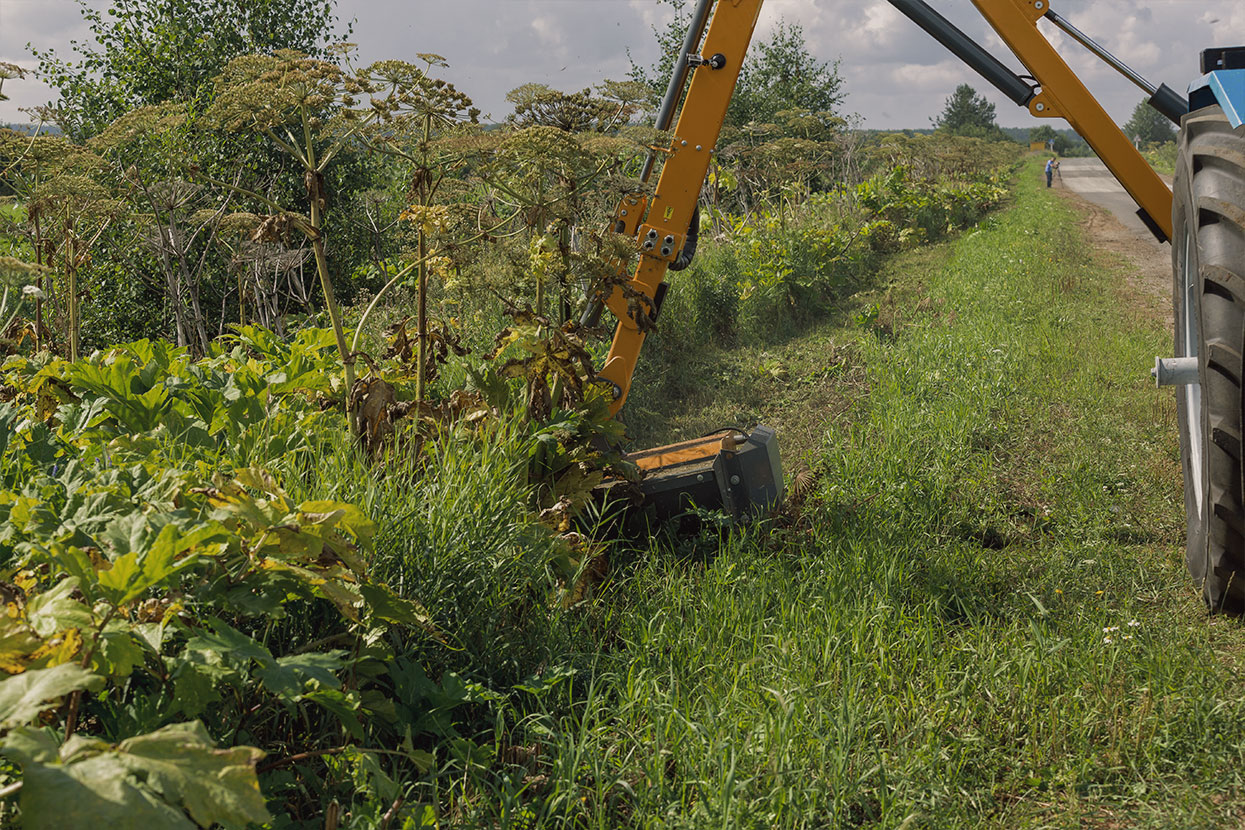
Green spaces in public areas require constant attention, yet site conditions and organisational constraints mean that standard mowing methods do not always work. Slopes, roadside ditches or zones next to technical infrastructure create problems that affect the pace of work, safety and maintenance costs. In such places, the priority becomes adapting the technology to the real conditions, not the other way round.
Why is maintaining green spaces in public areas often problematic?
Maintaining green areas in towns and along road infrastructure means reconciling the expectations of pedestrians, drivers, municipal services and landscape designers. At the same time, green spaces perform several roles at once:
- they stabilise the microclimate,
- they support water retention,
- they limit erosion,
- they affect visibility around roads.
At the same time, they have to be maintained within limited budgets and staffing. The requirements of climate adaptation and biodiversity protection mean that a uniform approach to mowing is no longer enough — the method of maintenance has to be differentiated according to the function of the area.
Where do standard mowing methods fail to deliver the expected results?
Conventional mowers lose effectiveness above all on slopes, in roadside ditches, on embankments and on steeply sloping ground. Self-propelled machines have limited stability or access there. The same applies to zones next to linear infrastructure — power lines or railway tracks.
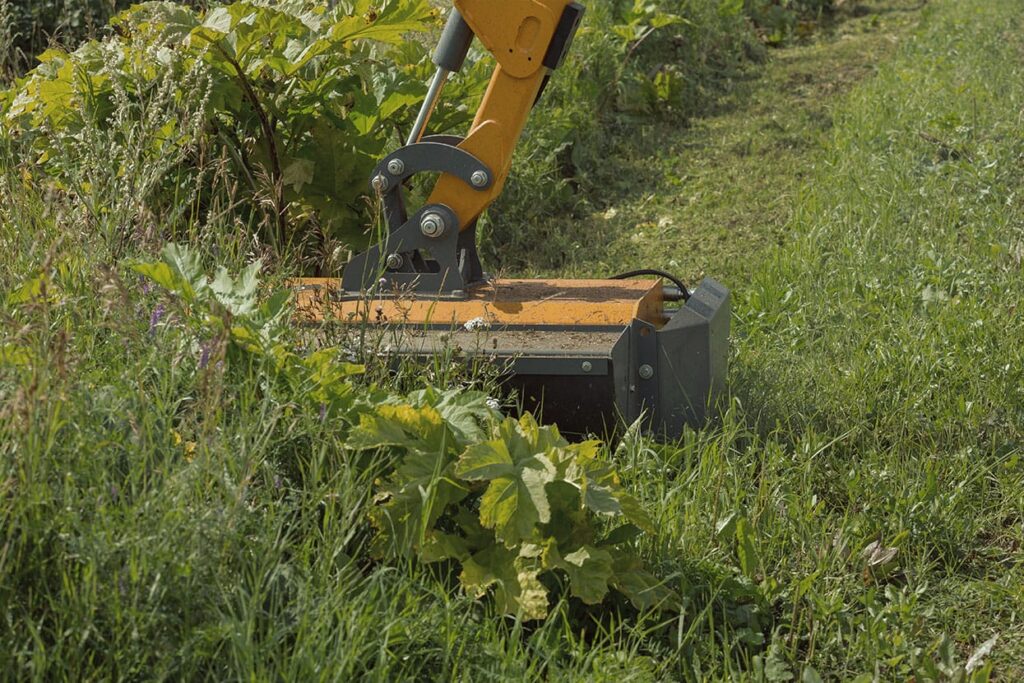
In practice, this means having to work from a safe distance. Equipment operating from the road or from stable ground is used, such as a boom mower. In dense urban development, the KR-Z POWER series with hydraulic second arm extension is particularly useful — the operator works around parked vehicles, shelters and barriers without repositioning the tractor. Where a lower carrier weight matters, the GHL125 lightweight mowing head is the right choice.
What organisational challenges do managers of public green spaces face?
Planning work without disrupting traffic and the use of the area
Any occupation of the road corridor requires diversions or restrictions to be organised. Mowing schedules are therefore split into stages and work is carried out at set times. A mower with a boom reduces the number of entries into difficult terrain — the operator works from the verge or the carriageway, so parts of the area do not have to be temporarily closed to users.
Safety of workers and bystanders
Slopes and ditches are particularly demanding, as there is a risk of the equipment losing stability. Boom mowers allow the operator to stay on stable ground while the working tool reaches hard-to-access spots. How a hydraulic arm differs from a complete machine, and what to look for when choosing one — we cover this in the post what are boom mowers.
Why does choosing the right technical solutions matter?
In places with a complex terrain structure, one type of machine is often not enough. The advantage of a boom mower is the interchangeability of working heads: the same machine carries a mowing head, a branch shear, a ditch cleaner or a sweeper. One carrier covers the whole season — from mowing to clean-up work — which, given the limited budgets of local authorities, has a direct impact on costs.
Boom mowers and the efficient maintenance of public green spaces
- Maintaining public green spaces requires technical and organisational constraints to be taken into account.
- Standard mowers are not effective on steep gradients or next to linear infrastructure.
- The organisation of work must minimise the impact on traffic and increase operator safety.
- Boom mowing systems with interchangeable heads handle many tasks with a single carrier.
The boom mowers offered by Rolmex Misiuda make it easier to plan operations and reduce operational problems. Contact us — we will advise on a configuration for your specific site.
FAQ
Why are standard mowers not always effective?
They cannot cope on slopes, in ditches and in places with restricted access — there, work from a safe distance, from the level of the road, is needed.
Does roadside work require special organisation?
Yes — coordination with the road authority, temporary signage and schedules that limit disruption to traffic.
What role does a boom mower play in mowing public green spaces?
It allows work from a safe position and reaches slopes, ditches and embankments, while interchangeable working heads make it possible to carry out many different jobs with a single carrier.