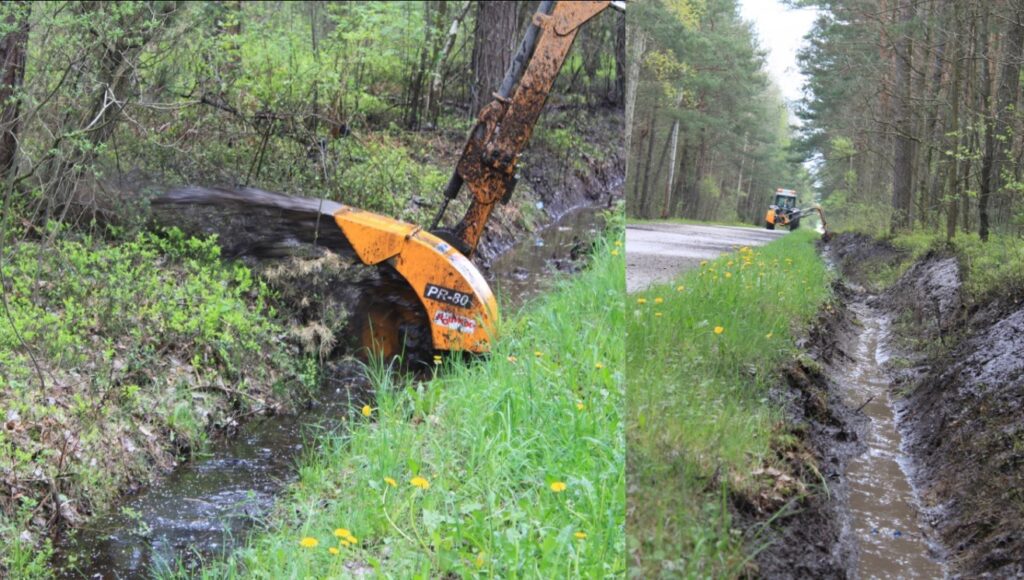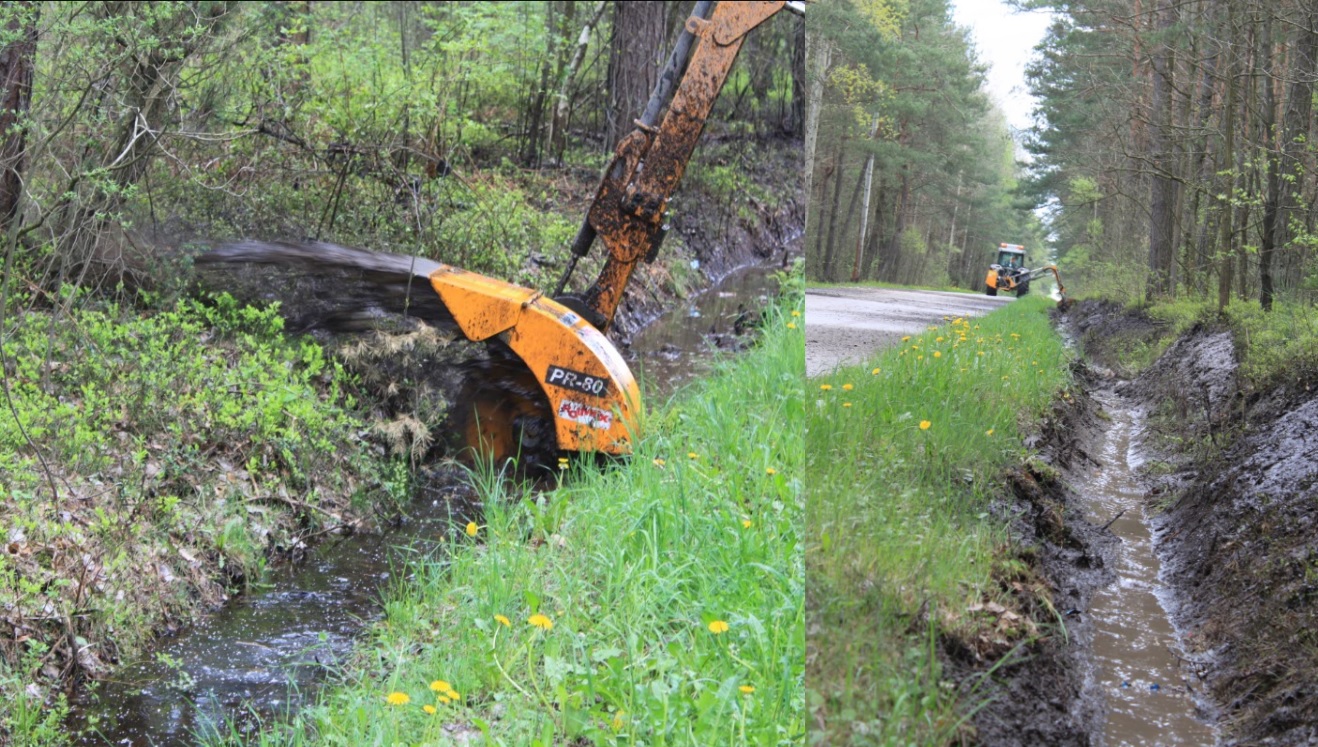
A ditch cleaner, also called a ditch dredger, is a working head mounted on the hydraulic arm of a boom mower, used to clean and deepen drainage and roadside ditches. In terms of function, all machines of this type do the same thing: they collect silt, roots and vegetation from the bottom and slopes of the ditch, and then discharge the spoil beyond the ditch outline through the ejection wheel and a directing flap.
In design terms, however, the differences are enormous — and it is they that decide whether a ditch cleaner will last one season or five. Below we break the subject down to its fundamentals, without marketing and without embellishment.
What is a ditch cleaner
A ditch cleaner (dredger) is a working head in which a hydraulic motor drives an ejection wheel fitted with cutting and extending blades. The machine works on a hydraulic arm (a boom mower) and performs three functions simultaneously:
- desilting — removing silt and organic sediment from the ditch bottom,
- deepening — restoring the designed ditch profile,
- spoil ejection — carrying the collected material beyond the ditch outline, controlled by the discharge flap.
In terms of SEO and industry language, the two terms — ditch cleaner and ditch dredger — are used interchangeably. The first name dominates in the land-drainage segment, while the second appears more often in the tender specifications of road authorities.
Two design variants — and why it matters
On the market you will find two fundamentally different ditch cleaner designs that look similar but differ in durability.
Variant 1 — hydraulic motor directly on the ejection wheel (no gearbox)
In the cheaper design, the output shaft of the hydraulic motor fits directly onto the hub of the ejection wheel. There is no intermediate mechanical component to absorb an impact.
Advantages:
- low price (the market value of such a machine starts at around PLN 20,000 net),
- simple construction, fewer parts,
- works properly under normal operating conditions.
Operational risk:
When the ejection wheel strikes an obstacle (a stone, a root, concrete, a piece of infrastructure), the entire impact energy is transferred directly to the shaft of the hydraulic motor. Typical consequences:
- bending of the hydraulic motor shaft,
- loss of alignment between the motor and the ejection wheel,
- the need to replace the motor — repair is usually uneconomical or impossible, because once deformation occurs the mounting alignment cannot be restored.
In public tenders where the tender specification does not require an intermediate gearbox, such a design is acceptable. Rolmex also produces a version without a gearbox, if the customer does not require otherwise and is focused on the lowest possible budget.
Variant 2 — ditch cleaner with an intermediate gearbox (the PR80 design)
In the PR80 ditch cleaner, Rolmex uses a mechanical gearbox between the hydraulic motor and the ejection wheel. The gearbox performs two functions:
- it selects the optimum rotational speed of the ejection wheel regardless of the characteristics of the hydraulic motor,
- it protects the hydraulic motor in the event of an impact with an obstacle — the energy is absorbed by the gearbox assembly rather than directly by the motor shaft.
A car analogy: an engine without a gearbox will also run, until it seizes. A gearbox is not a luxury — it is a component that ensures the durability of the drivetrain. In a ditch cleaner, the gearbox plays exactly the same role.
What to look for when choosing a ditch cleaner — a checklist for the tender specification
When purchasing a ditch cleaner — especially under public procurement — it is worth checking the following design parameters. Each of them has a real impact on the machine’s durability in service.
1. How the hydraulic motor is connected to the ejection wheel
- directly (motor shaft → ejection wheel) — the cheaper variant, less resistant to obstacles,
- through a gearbox — the more durable, more expensive variant, recommended for intensive use.
Recommendation for the tender specification: if the machine is to work in unfamiliar terrain (neglected ditches, a risk of contact with obstacles), require an intermediate gearbox.
2. Material and thickness of the ejection wheel
The ejection wheel is the component exposed to the greatest mechanical loads — and at the same time the one that most often decides the durability of the whole machine. In the PR80 ditch cleaner, the ejection wheel is made of S355 steel plate 22 mm thick — a solution that goes beyond the standard for this class of machine available on the Polish market.
Recommendation for the tender specification: specify the minimum plate thickness of the ejection wheel and the steel grade (S355 as a minimum).
3. Material and thickness of the cutting and extending blades
The blades are a wear part — but the quality of the material decides whether they are replaced every season or every few years. In the PR80 ditch cleaner, both the cutting and the extending blades are made of boron steel 12 mm thick. Boron steel is characterised by high hardness and abrasion resistance — it significantly outperforms the ordinary structural steel used in cheaper designs.
Recommendation for the tender specification: specify the type of blade steel (boron) and the minimum thickness (12 mm).
4. Control of the discharge flap
The discharge flap directs the stream of spoil beyond the ditch outline. Two design solutions:
- a fixed flap (set manually before work),
- a flap controlled hydraulically from the cab — the operator changes the discharge direction during work, adapting it to the terrain conditions (a line of trees, poles, vehicles in the roadway).
The PR80 ditch cleaner has a hydraulic cylinder controlling the discharge flap. This means the operator can smoothly change the discharge direction during work — which is impossible in designs without a cylinder.
Recommendation for the tender specification: require hydraulic control of the discharge flap from the operator’s cab. This requires a hydraulic line routed out from the arm of the boom mower.
5. Required hydraulic supply parameters
The ditch cleaner is a hydraulic attachment and its performance depends directly on the hydraulic parameters of the carrier (a tractor, a municipal vehicle, a hydraulic arm).
For the PR80 ditch cleaner, the recommended supply parameters are:
- a hydraulic pump output of at least 110 l/min,
- an additional hydraulic outlet for the cylinder controlling the discharge flap.
In the catalogue data sheets of some machines available on the market you can find declared required flows of the order of 200 l/min and higher. It is worth noting the discrepancy between catalogue declarations and the real parameters of the pumps available in the carriers used in Polish tenders. If the carrier does not deliver the declared flow, the machine will never reach its nominal operating parameters — regardless of the manufacturer’s marketing.
Recommendation for the tender specification: specify the required hydraulic flow realistically, in line with the parameters of the carriers you own.
The PR80 ditch cleaner — a Rolmex Misiuda product
The PR80 ditch cleaner is a working head manufactured by Rolmex Misiuda Sp. z o.o. — a Polish manufacturer of road and land-drainage machinery based in Kielce, present on the market since 1986.
Key design features of the PR80:
- an intermediate gearbox between the hydraulic motor and the ejection wheel,
- an ejection wheel made of S355 steel plate 22 mm thick,
- cutting and extending blades made of boron steel, 12 mm plate,
- a hydraulic cylinder controlling the discharge flap,
- mounting on KR-type hydraulic arms (Rolmex boom mowers) with a routed hydraulic harness,
- required supply: at least 110 l/min + a control outlet for the flap cylinder.
The PR80 is an attachment dedicated to Rolmex boom mowers and can be installed as one of the interchangeable heads alongside mowing heads, stump cutters, branch guillotines or sweepers. You will find the full PR80 product data sheet on the PR80 ditch cleaner page.
The economy version — when the tender specification does not require a gearbox
Rolmex also produces ditch cleaners in an economy version, without an intermediate gearbox — with the hydraulic motor seated directly on the hub of the ejection wheel. This is a technically and economically sound solution if the customer does not require a gearbox design in the tender specification and is targeting the purchase price.
In every case the customer gets a choice: the economy version (lower purchase price, lower resistance to obstacles) or the PR80 version with a gearbox (higher purchase price, higher durability in demanding conditions).
Frequently asked questions (FAQ)
What is the difference between a ditch cleaner and a ditch dredger?
None. Ditch cleaner and ditch dredger are two names for the same machine. The term “ditch cleaner” emphasises the function of removing silt and sediment, while “ditch dredger” emphasises the function of restoring the ditch profile. In industry practice and in tender specifications, the names are used interchangeably.
How much does a ditch cleaner cost?
The price depends on the design variant. A ditch cleaner in the economy version (motor directly on the ejection wheel) starts at around PLN 20,000 net. A ditch cleaner with an intermediate gearbox, an S355 22 mm ejection wheel and boron steel blades (the PR80 model) is priced individually — the price takes into account the technical requirements of the carrier and any additional hydraulic equipment.
What hydraulic arm do I need in order to mount the PR80 ditch cleaner?
The PR80 is dedicated to Rolmex KR-series boom mowers with a routed hydraulic harness (head supply + discharge flap cylinder line). Installation on other arms is also possible — this requires an individual check of the carrier’s hydraulic and mechanical parameters.
What hydraulic flow is required for the PR80 ditch cleaner?
At least 110 l/min on the head supply, plus an additional hydraulic outlet for the cylinder controlling the discharge flap.
Can I replace the blades on the ditch cleaner myself?
Yes. The cutting and extending blades in the PR80 are a replaceable part — made of boron steel, 12 mm plate. The replacement frequency depends on the operating conditions.
Summary
Choosing a ditch cleaner is a technical decision, not a marketing one. Four parameters that genuinely decide the machine’s durability:
- the presence of an intermediate gearbox between the hydraulic motor and the ejection wheel,
- the material and thickness of the ejection wheel (S355 22 mm in the PR80),
- the material and thickness of the blades (boron steel 12 mm in the PR80),
- hydraulic control of the discharge flap (standard in the PR80).
All four parameters can be written into the tender specification and confirmed by bidders in their catalogue data sheet. This is the simplest way to avoid a situation in which a machine bought for PLN 20,000 net needs its hydraulic motor replaced in its second season.
Contact regarding the PR80 ditch cleaner: PR80 ditch cleaner