
Maintaining the road right-of-way can rarely be closed within a single machine. One ROLMEX delivery included four items which together cover successive jobs in the season: mowing slopes and verges, desilting ditches and pruning branches. Below we break this set down into its parts and explain what the parameters of the individual machines mean in practice.
What the delivery included
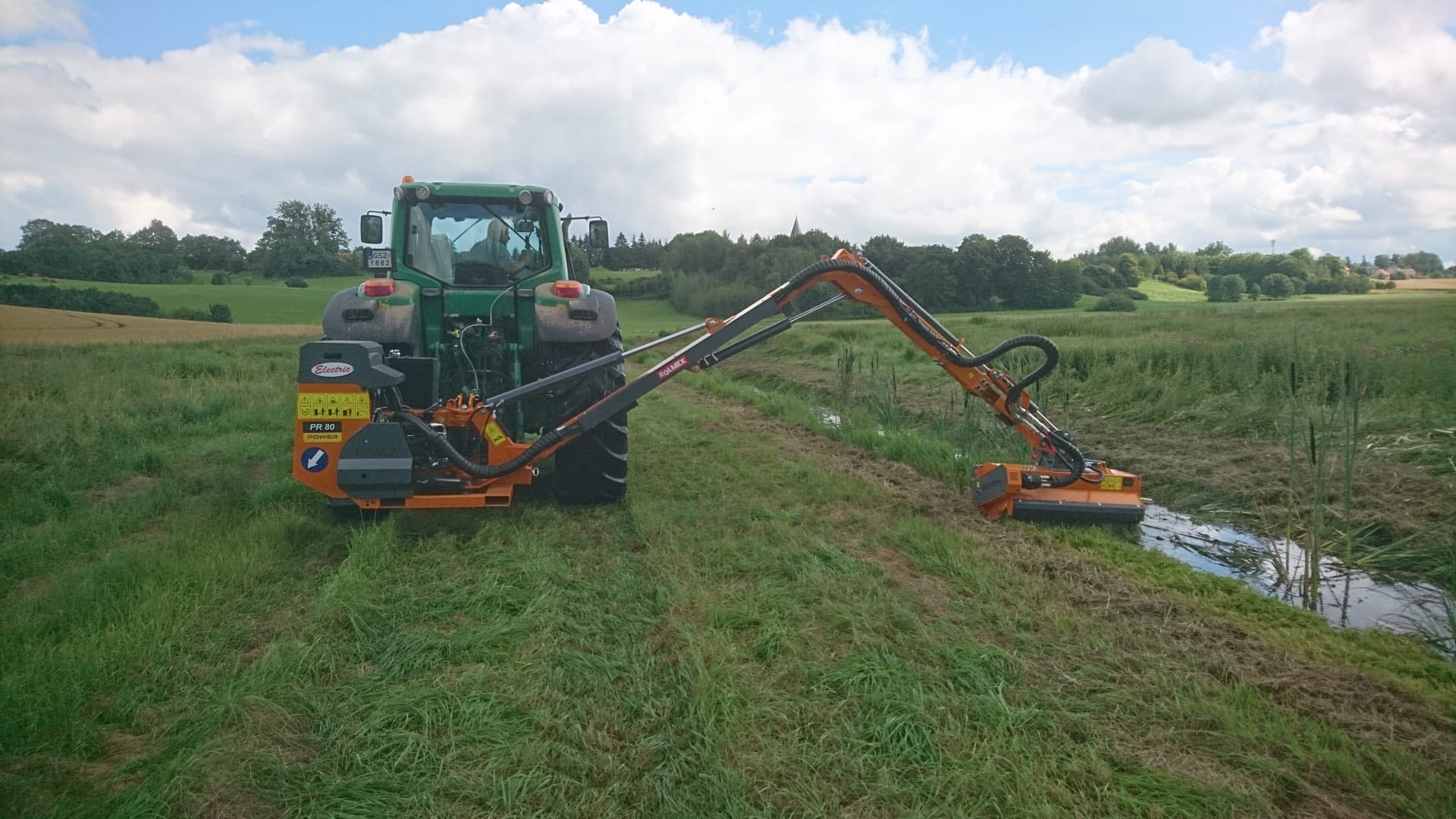
- a hydraulic arm with a mowing head mounted on a John Deere tractor,
- a PR-80 desilting head for drainage ditches,
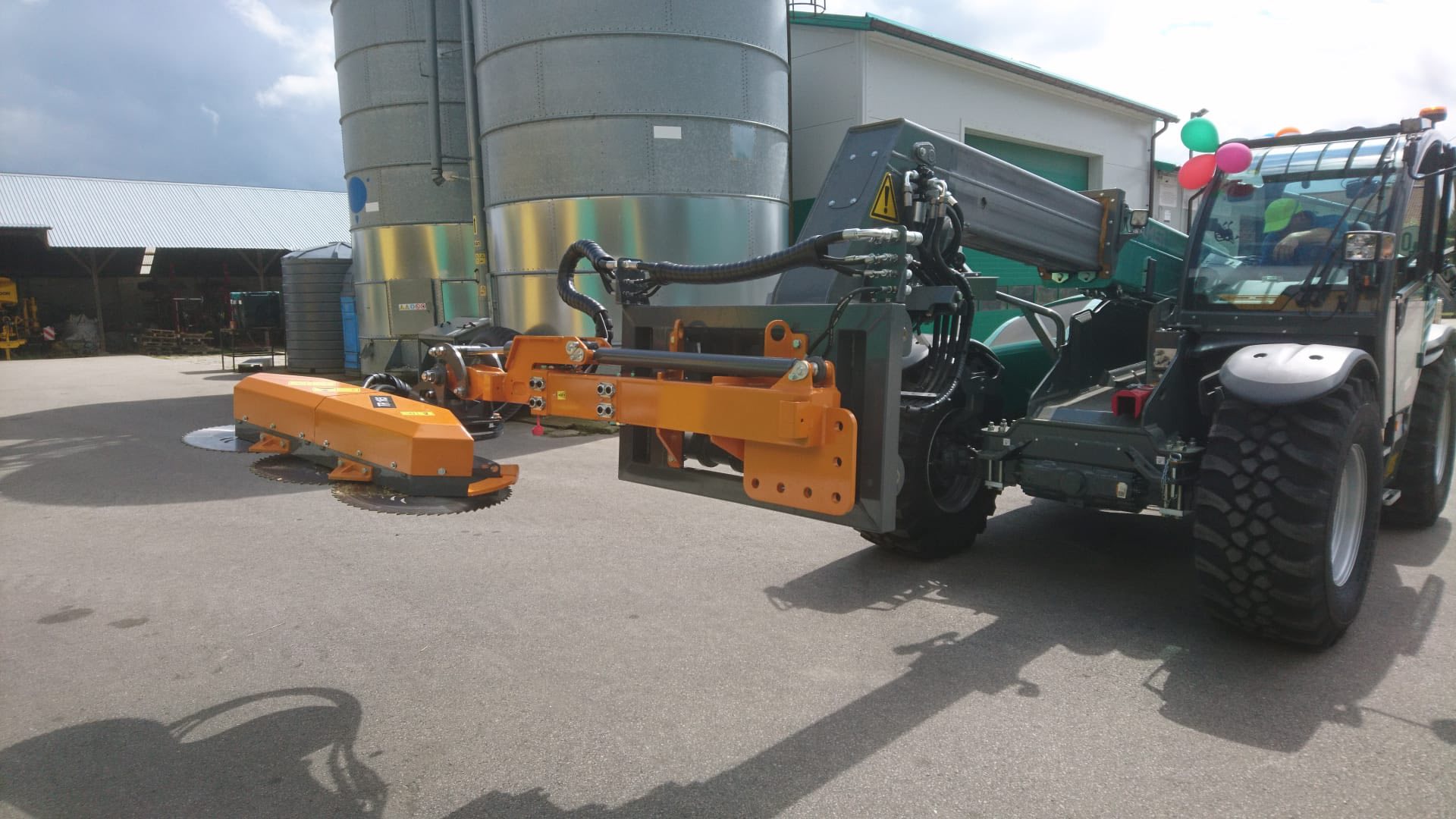
- a disc saw mounted on a Kramer loader,
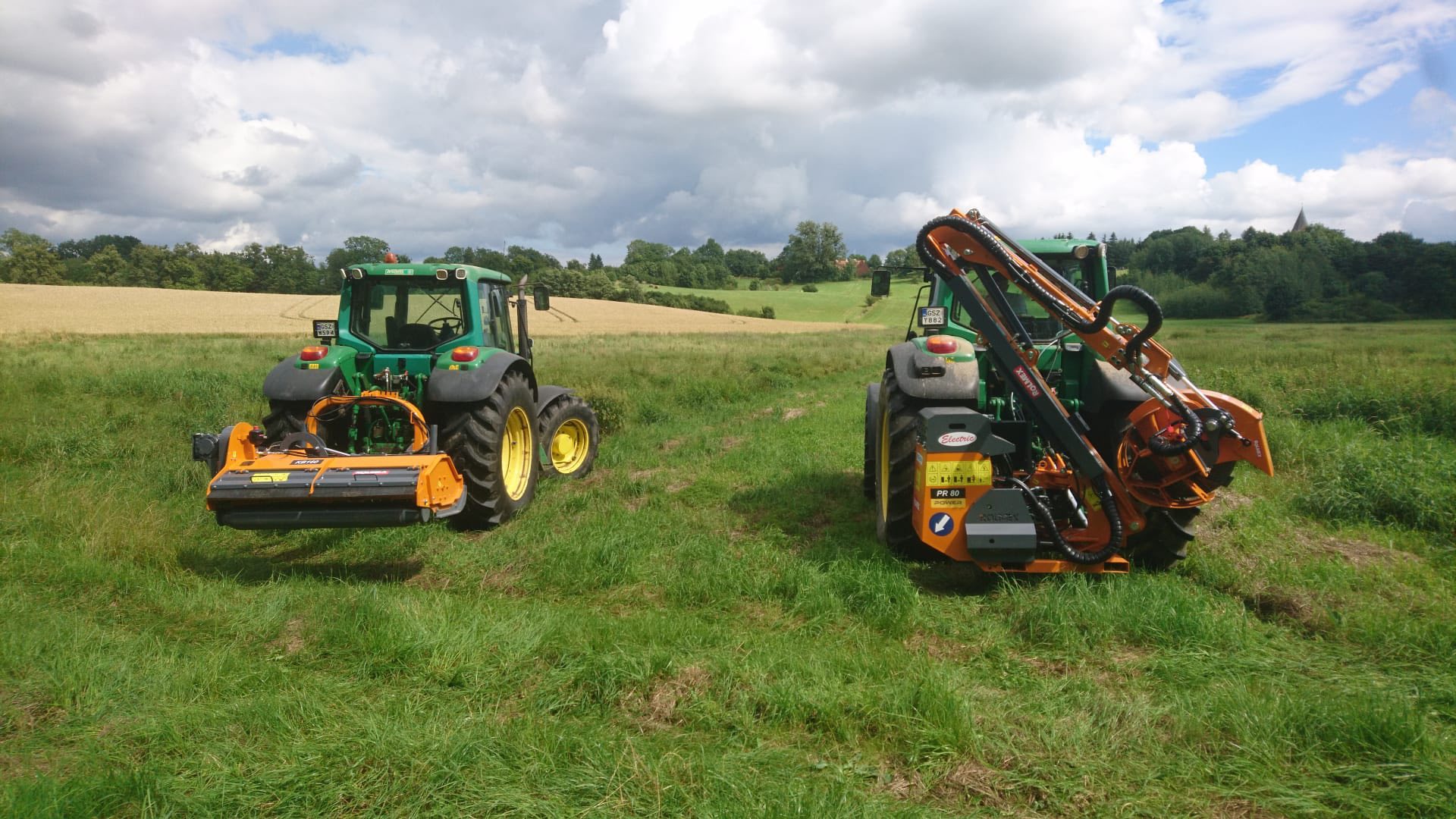
- a KB160 rear-side mower with opening flaps and a shock absorber.
The set therefore contains two different carriers — a tractor and a loader — and a machine hitched to the three-point linkage. The arm with interchangeable heads handles mowing and desilting, the saw works higher up, at the tree crowns, and the rear-side mower takes over the repetitive kilometres of verge.
A hydraulic arm on a tractor: what decides the choice of carrier
An arm with a mowing head is the basic tool of a road authority, because it makes it possible to mow the slope, the ditch bottom and the verge without taking the wheels off the hard surface. Whether the set will be stable, however, is decided by the tractor and not by the arm itself. For the KR POWER series power arm mowers the manufacturer gives specific requirements:
- KR-520 – maximum arm reach 5.6 m, required tractor power 100 HP, minimum weight 4000 kg, minimum tractor width 200 cm,
- KR-600 – maximum arm reach 6.5 m, required tractor power 110 HP, minimum weight 4500 kg, minimum tractor width 220 cm,
- an independent hydraulic system with a cooler and a pump delivering up to 130 l/min, and a high-performance oil cooler with a thermostat.
The weight and width of the carrier are the counterbalance for the arm extended to the side – the further the arm reaches, the heavier and wider the tractor has to be. The KR520 data sheet notes that these three values have to be checked together, because power alone is not enough. The reach, in turn, translates directly into how much of the slope a single pass will cover.
Matching the head to the job
The PR-80 ditch cleaner for drainage ditches
A silted ditch stops taking water off the carriageway. The PR80 ditch cleaner works as an interchangeable head on the power arm: a disc 80 cm in diameter lifts the silt out of the ditch bottom and throws it clear of the ditch. The head weighs 300 kg, the working pressure is 220–240 bar, and the required minimum oil flow is 120 l/min at 200 bar or 100 l/min at 300 bar – the first thing to check before the head goes onto an existing arm. The manufacturer also gives the possibility of cutting roots up to 10 cm in diameter and an internal gearbox protecting the motor, and describes the unit itself as designed to work in conditions of high ground moisture, typical of the autumn and spring season. The discharge control cylinder is optional equipment, and fitting and removing the head takes 3–4 minutes.
The disc saw for pruning
Pruning branches that intrude into the clearance envelope is a job for a disc saw. TR series heads are mounted on power arm mowers and on construction machines of various makes – which is why in the delivery described here the saw works on a loader and not on a tractor. The scale is shown by the data sheet of the TR disc saws: the TR155 model has a working width of 1550 mm, cuts material up to 150 mm in diameter and works with three discs 600 mm in diameter driven by three hydraulic motors, in the maintenance-free version – with no belts, chains or lubrication system. A variable head attack angle of up to 15˚ makes it possible to keep an even cutting line along the road.
KB160 – mowing the verge without leaving the carriageway
The fourth machine is the KB160 rear-side mower from the series of heavy-duty flail mowers on a pantograph. The manufacturer gives the following figures for it:
- working width 1.6 m,
- mower reach 2.6 m,
- weight 730–790 kg, depending on the type of rotor, the type of blade, the size of the support roller and the remaining options,
- mower rotation angle -65° / 90°.
The pantograph shifts the working unit parallel to the side, so the mower moves outside the outline of the tractor while the wheels stay on the hard surface. The range from -65° to 90° means that a single machine will mow the ditch bottom, the slope below the road and the slope rising above the verge. The two hinged rear flaps speed up the mowing of taller grass, wasteland, reeds and blackthorn, and at the same time allow the blades to be checked quickly without standing the mower upright. Additional equipment includes a hydraulic-gas shock absorber. “T” type hammers cope with branches up to Φ80 mm of dry wood, and the version with YS blades on a shackle gives, according to the manufacturer, the best mowing quality.
Why a set and not a single machine
Each of these tools works on a different element of the road right-of-way and at a different point in the season. The arm with interchangeable heads makes it possible to handle mowing and desilting with one carrier, the saw on a separate machine takes the work in the tree crowns off it, and the rear-side mower takes over the most repetitive kilometres of verge. When planning such a set it is worth starting with three things: the oil flow and pressure required for the heaviest head planned, the weight and width of the carrier, and the reach needed for the widest ditch in the managed network.