
A boom mower bought solely for mowing grass actually works from May to September and stands under a shelter for the rest of the year. That is not the machine’s fault, but the fault of the way it is planned: as a mower, not as an attachment carrier. The hydraulic arm itself cuts nothing — the head coupled to its end decides what work it will do.

A rig that stands idle for most of the year pays for itself slowly. The same rig with a full set of interchangeable heads works on snow in January, on the verge in March, on grass in May, in reeds in August and on leafless bushes in December. The tractor, the operator and the hydraulics stay the same — only the attachment at the end of the boom changes.
Below is a twelve-month work calendar for the ROLMEX KR600Z arm: what to do, why at that particular time, which head to mount and what to watch out for. Plus a summary table and how to match the heads to your own tractor.
Why boom mowers do not have to stand idle outside the mowing season
Four specialised machines — a mower, a verge cutter, ditch equipment and a winter set — mean four purchases, four parking spots, four sets of servicing and spare parts, and four operators. One hydraulic arm with a set of heads means one tractor, one operator, one hydraulic system and one rig to transport to the road section.
This shows especially in short weather windows. In February or November, being able to switch from the sweeper to the verge cutter on the same day can be worth more than the output of a single pass, and swapping the head on the same arm is workshop work, not a machine rebuild. That is why boom mowers are worth buying together with their attachments.
The KR600Z arm carries, among others:
- GHL125 — light mowing head (1.25 m, 270 kg): grass and low growth in the road corridor.
- GH120 — heavy flail head (120 cm): reeds, goldenrod, woody regrowth.
- RAGNAR100 — heavy mulching head (100 cm, 340 kg) for shredding cuttings and bushes.
- KD — head for destroying shrubs and thickets (1.2 m, 180 kg).
- TGR-155 — branch shear (1550 mm); TR — three-disc saw (1300 mm).
- SP90 — verge cutter and milling head (90 cm, 300 kg).
- PR80 — ditch cleaner for roadside ditches.
- GS70 — weed remover for block paving (70 cm, 140 kg).
- ZMX-160 — boom-mounted sweeper (1.6 m, 170 kg).
- SWB100H — snow blower for snow removal (1000 mm, 166 kg).
- FP — stump cutter (Ø40 cm disc, 220 kg); WK — column auger drilling down to 100 cm.
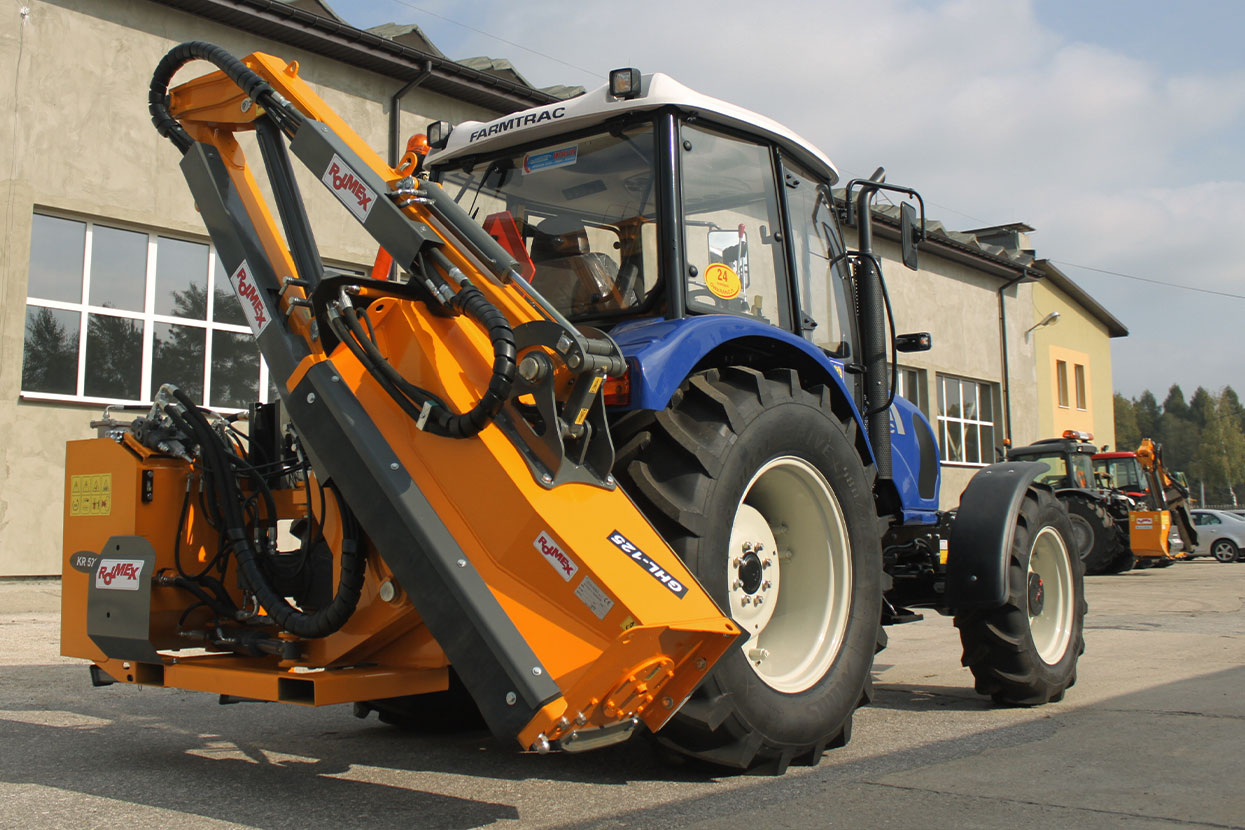
KR600Z — the parameters that decide its versatility
The KR600Z from the KR-Z POWER series has a telescopic second arm. It is what lets you reach the outer embankment and the ditch bottom without putting the wheels into the ditch, and in winter throw the snow windrow beyond the embankment. 68 HP at the head shaft drives not only the light mowing head but also the mulcher, the verge cutter and the ditch cleaner — which is why this boom mower has work all year round.
| Parameter | KR600Z | KR700Z |
|---|---|---|
| Maximum boom reach | 6.4 m | 7.5 m |
| Power at the head shaft | 68 HP | — |
| Required tractor power | 110 HP | 130 HP |
| Minimum tractor weight | 4500 kg | 5000 kg |
| Minimum tractor width | 220 cm | — |
These requirements are not a formality. With a head weighing 300–340 kg extended to the full 6.4 m, the tipping moment is real — hence the minimum of 4500 kg of tractor weight and 220 cm of tractor width. A rig matched according to the table works from the verge; one matched “just barely” works from the traffic lane, because the operator is afraid to move onto the edge.
Boom mower work calendar: 12 months, 12 jobs
January — clearing snow from the roadway, verges and lay-bys
After the front plough, a snow windrow remains on the verge: it narrows the roadway and buries entrances, lay-bys and ditch outlets. An arm with 6.4 m of reach throws it beyond the embankment, which a front plough cannot do. Frozen ground carries the tractor well, so the machine drives along the edge of the verge without the risk of rutting.
Tip: work into a compacted windrow in layers, not at its full height, and set the discharge with the wind. A frozen stone can damage the auger.
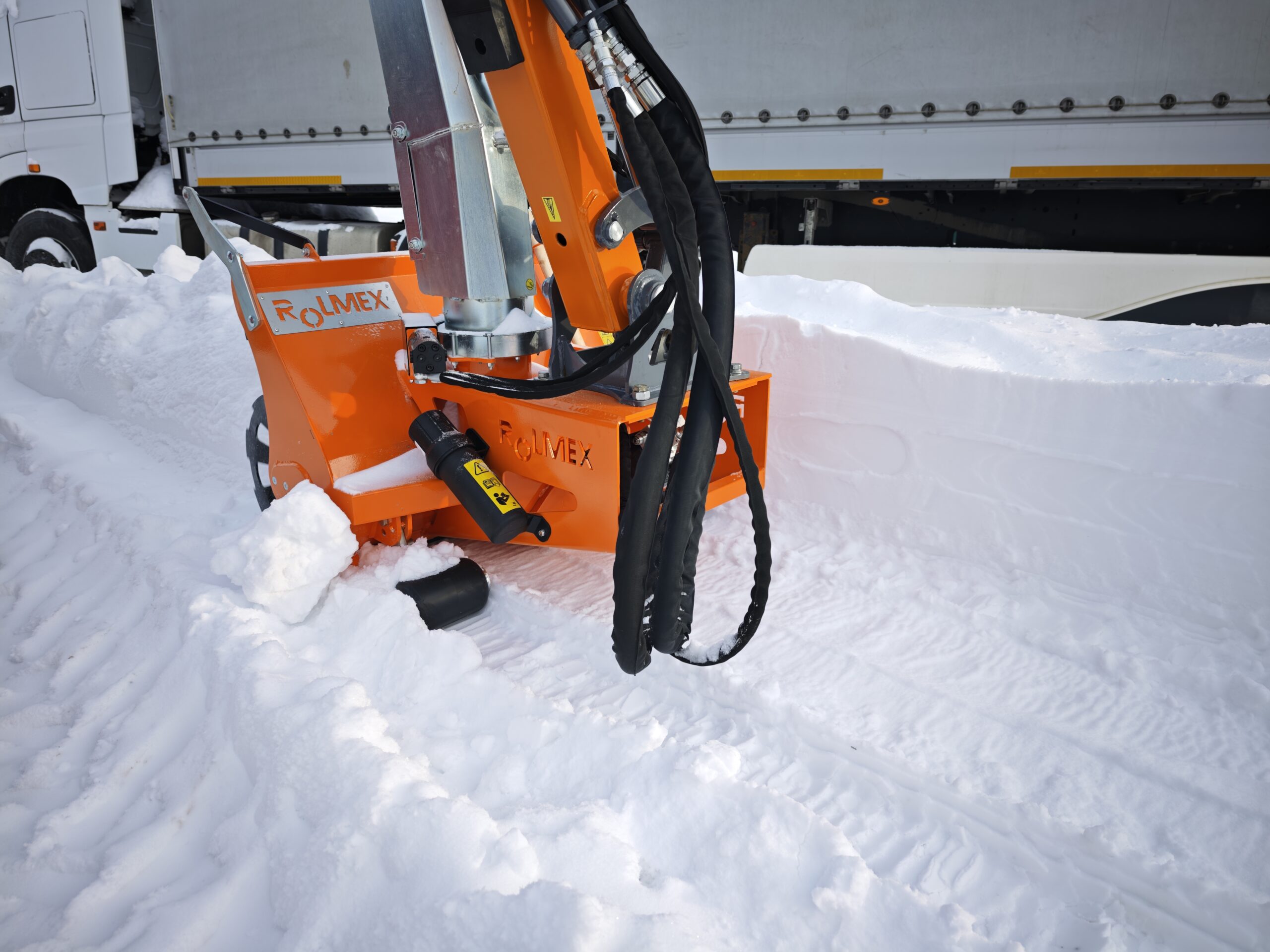
Head: SWB100H — working width 1000 mm, Ø400 mm auger, Ø440 mm rotor, 166 kg.
February — snow clearing plus sweeping edge strips and lay-bys
February is a cycle of freezing and thawing, and water entering the pavement edge causes break-up. The snow is wet and heavier than in January, so the windrow all the more needs to be thrown beyond the embankment. Grit from the whole winter lies in the lay-bys — left uncollected, it will wash down into the ditch, which will have to be cleaned in March anyway.
Tip: run the sweeper at an angle to the direction of travel, so that the material moves off to one side. Slow down on wet sand — the brush then picks up more and scatters less.

Head: ZMX-160 — 1.6 m, 2000 rpm, Ø40 cm brush, 40 HP, 170 kg; for snow, still the SWB100H.
March — cutting built-up verges and cleaning ditches
After winter the unpaved verge sits higher than the asphalt edge: silt, sweepings, winter spoil, turf growth. Water from the roadway has no outflow, and that is the direct cause of spring pavement break-up. The ditches are now at their most silted of the year, and vegetation has not yet started — you can see the real profile, the drain outlets and the culvert inlets.
Tip: mill from the pavement edge outwards, working a fall towards the ditch and not going below the asphalt level. Keep the required flow, minimum 110 l/min.

Head: SP90 — 51 knives (Hardox 550), working width 90 cm, min. 110 l/min, 300 kg; then the PR80.
April — finishing the ditches and weeding block paving
The last wide window for ditches before full vegetation: the bottom is visible and the ground is moist enough for the silt to come off without undercutting the embankment. It is also a good time for drilling holes for posts and plantings — the WK auger goes down to 100 cm. In bush-covered ditches, remember the bird nesting season and check local arrangements beforehand. On block paving the weeds are at the seedling stage, so one pass keeps the surface clean for weeks; in summer the same weed is much harder to remove.
Tip: guide the head along the joint with minimal down pressure — excessive pressure washes out the jointing sand and the blocks start to move under wheels.
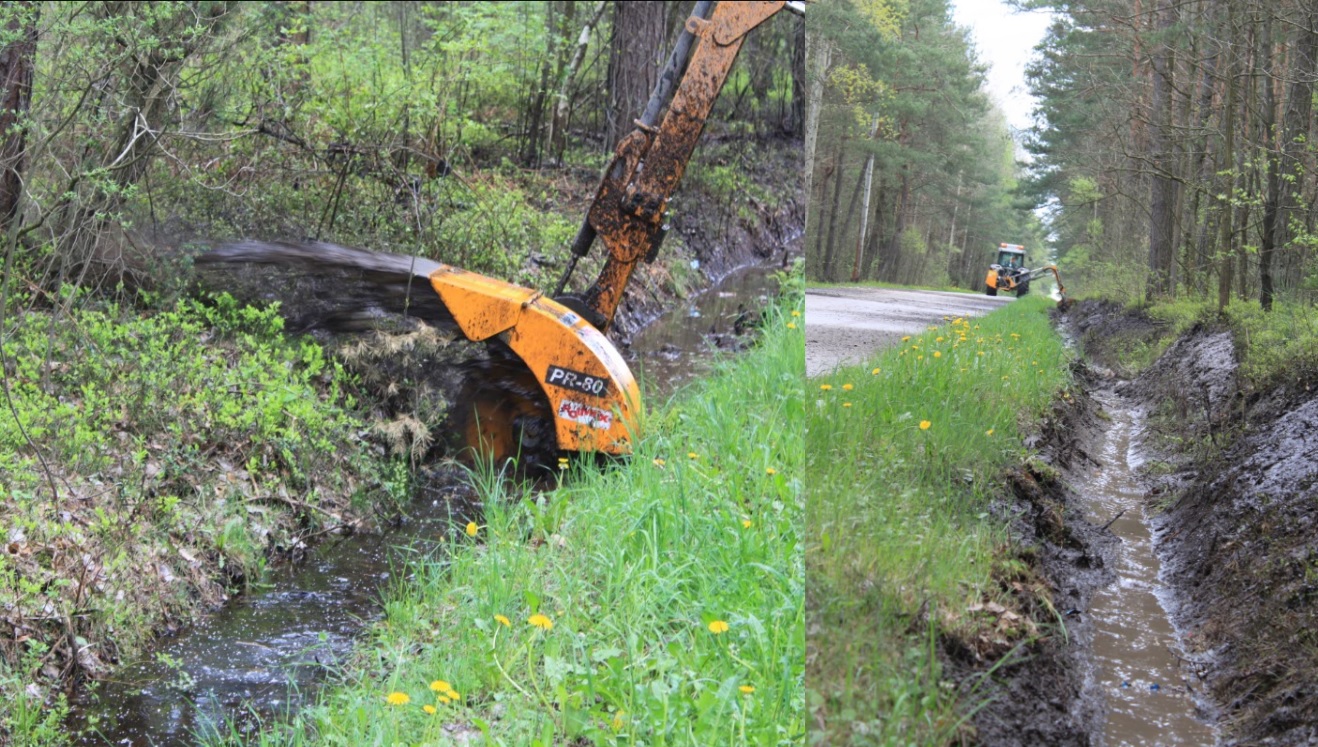
Heads: PR80 (min. 120 l/min at 200 bar), GS70 (70 cm, 200 bar, 90–120 l/min, 140 kg) and WK (holes down to 100 cm, Ø150×800 and Ø350×500 mm drill bits).
May — the first grass cut in the road corridor
Grass in the road corridor grows fastest then, and within a few weeks it hides sign faces, guide posts and the insides of curves. The first cut is done for visibility, not for looks, so the order of sections is set by sight triangles, entrances and approaches to pedestrian crossings. The growth is soft, so a light head with swinging knives is enough.
Tip: do not mow in the dew, because wet grass chokes the rotor. Set the skids a few centimetres above the ground, otherwise you will wear down the knives and tear out the turf.
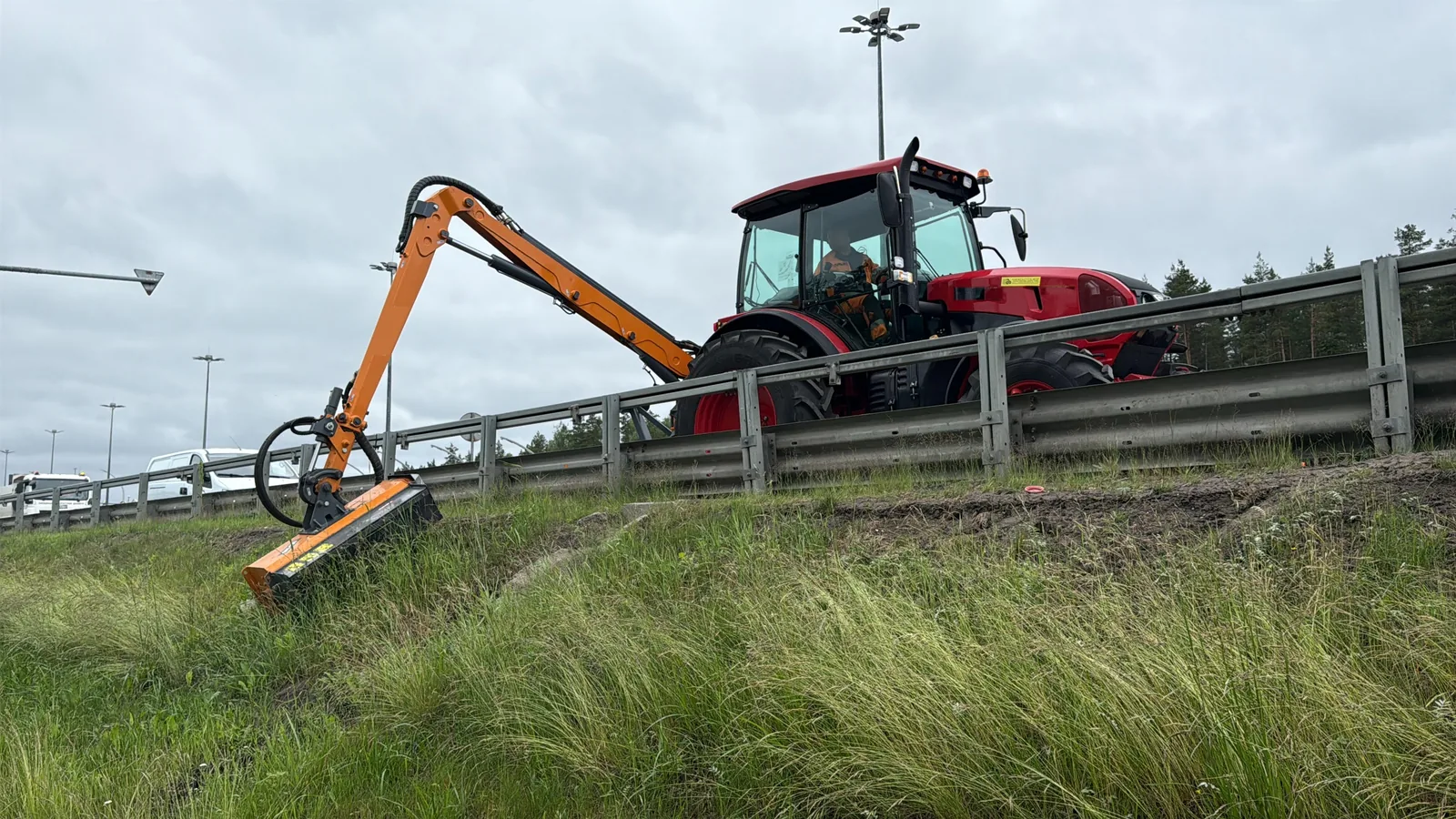
Head: GHL125 — working width 1.25 m, 68 HP at the shaft, 270 kg.
June — the second cut: ditch embankments and the strip along barriers
June is when grasses flower and set seed; cutting before the seeds drop limits how dense the sward gets next season. The ground is firm, so the tractor stands on the verge, not in the traffic lane. The 6.4 m reach with the telescopic second arm lets you mow the outer embankment and the ditch bottom without putting the wheels into the ditch.
Tip: switch on the arm float and work with ground-contour following. Set the head angle so that the cuttings fly towards the ditch, never onto the roadway.
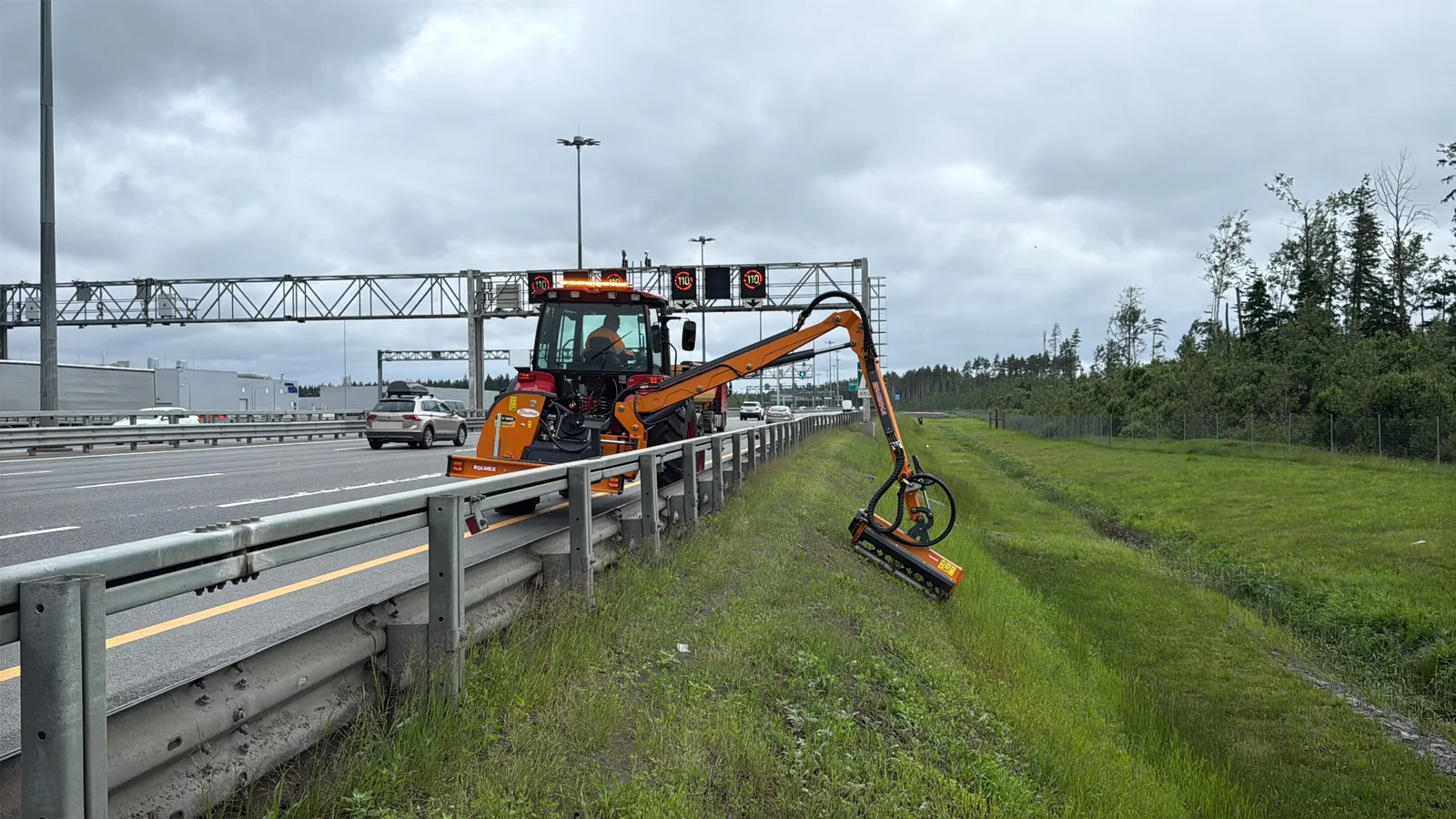
Head: GHL125 on an arm with 6.4 m of reach and a telescopic second arm.
July — spot mowing: curves, signs, the strip along barriers
Growth slows because of drought, but not on the verge, where run-off from the roadway keeps supplying water. Instead of mowing the whole length of a section, you make spot passes: curves, entrances, sign faces, refuge islands. It is the month of peak traffic, so work moves to early morning and late afternoon.
Tip: the pace is set by the oil temperature, not the grass. Clean the oil cooler — it clogs with dust quickly, and overheated oil means a drop in power at the shaft.
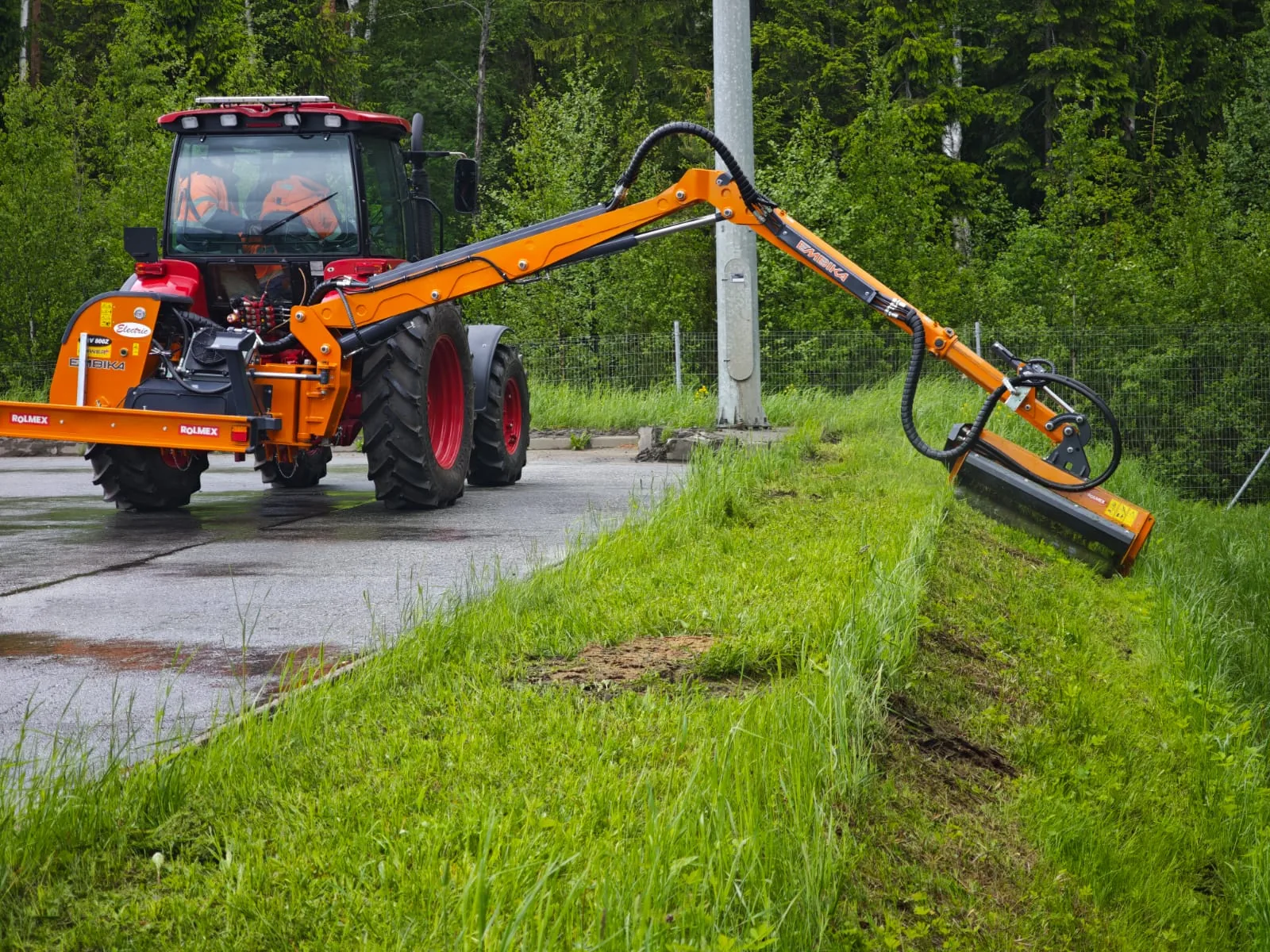
Head: GHL125 — 1.25 m working width with 68 HP at the shaft.
August — grass and reeds in ditches and on wetland ground
Late summer usually brings the lowest water levels: roadside and drainage ditches are dried out, so the head can be put into the embankment and onto the bottom without the risk of the spoil turning into mud. Reeds, goldenrod and willow saplings are tall by then and woody at the base — a light head lays them flat but does not shred them.
Tip: slow down and keep the rotor at full speed. A flail cuts with its tip speed, and choking it ends with material wrapped around the shaft.

Head: GH120 — width 120 cm; chain guards, flap cylinder and belt transmission as options.
September — weeding block paving and the last full cut
The second treatment of the season on the paving: the weeds have regrown, but most have not yet dropped seed, so removing them now reduces the pressure next year. Joints and edge strips need cleaning before leaf fall — soaked organic matter freezes in winter and can burst the block layout apart; the ZMX-160 sweeper then collects the sweepings. The last full cut has time to decompose instead of rotting through the winter.
Tip: work at the lower end of the 90–120 l/min range and more slowly, otherwise the brush pulls out the jointing sand together with the weeds.

Head: GS70 — 70 cm, 200 bar, 90–120 l/min, 140 kg; plus the GHL125 and ZMX-160.
October — verge cutting and ditch cleaning before winter
The most important window of the year for pavement durability. If a built-up verge and a silted ditch go into winter, water will stop under the asphalt edge, freeze and cause frost heaves and break-up that in spring cost many times more than the cutting itself. Vegetation is dying back, so the cut growth does not come back before spring.
Tip: check the knives after every shift and replace them in pairs or as a full set. Deposit the spoil beyond the embankment, never into the ditch.

Head: SP90 — 300 kg; tractor min. 4500 kg and 220 cm wide; followed by the PR80.
November — finishing verge cutting and ditch cleaning
The last realistic date for earthworks: once the top layer freezes, neither the verge cutter nor the ditch cleaner will get into the ground, and working in frozen ground ends with broken-off knives. Night frosts work in your favour — in the morning the verge is firm, in the afternoon it softens just enough to be milled. The leaves have just come down, so they are removed together with the silt.
Tip: at dusk switch on full work lighting and mark the rig — a boom extended to 6.4 m can be hard to see for approaching drivers.

Head: PR80 — min. 120 l/min at 200 bar, alternatively 100 l/min at 300 bar; in parallel the SP90.
December — cutting branches and mulching bushes
In winter the regrowth and undergrowth are leafless: the operator sees the layout of the limbs and the actual road clearance envelope, and the mass to remove is much smaller than in summer. The wood is frozen through, so the shear and the disc saw give a clean cut. Frozen ground gives bearing capacity on embankments and wetland ground where a tractor cannot go in summer.
Tip: first the TGR-155 or the TR cuts and lays the material on the verge — in dense thickets the KD works faster — then the RAGNAR100 shreds the cuttings on the spot, and the FP cutter takes care of the remaining stumps. Do not mulch material lying on stones.


Heads: TGR-155 (1550 mm, material up to 120 mm, 180–235° rotation, 0.2–0.7 km/h), TR (1300 mm, material up to 120 mm, variable attack angle up to 15°), KD (1.2 m, 180 kg, min. 110 l/min), RAGNAR100 (100 cm, 340 kg) and FP (Ø40 cm disc, 1800–2250 rpm, 220 kg).
The calendar in one table
| Month | Job | Head |
|---|---|---|
| January | Clearing snow from the roadway, verges and lay-bys | SWB100H |
| February | Snow clearing, sweeping edge strips and lay-bys | ZMX-160, SWB100H |
| March | Verge cutting, ditch cleaning | SP90, PR80 |
| April | Ditches, weeding block paving, drilling | PR80, GS70, WK |
| May | First cut — sign visibility | GHL125 |
| June | Second cut — embankments and barriers | GHL125 |
| July | Spot mowing: curves, entrances, signs | GHL125 |
| August | Reeds and grass in ditches | GH120 |
| September | Block paving, last full cut | GS70, GHL125, ZMX-160 |
| October | Verge cutting and ditches before winter | SP90, PR80 |
| November | Earthworks before the ground freezes | PR80, SP90 |
| December | Branch cutting, bush mulching, stump cutting | TGR-155, TR, KD, RAGNAR100, FP |
How to match the heads to your own tractor
Four numbers decide how many items from this calendar you will actually carry out. Oil flow is the most important: the KD and SP90 require a minimum of 110 l/min, the PR80 120 l/min at 200 bar or 100 l/min at 300 bar, the GS70 works in the 90–120 l/min range. With a weaker pump the head will not “just work more slowly” — it will start to choke and clog with material. Pressure: the GS70 works at 200 bar, the PR80 at 200 bar and 120 l/min or at 300 bar and 100 l/min.
Head weight rises from 140 kg (GS70) and 166 kg (SWB100H), through 170 kg (ZMX-160), 180 kg (KD), 220 kg (FP) and 270 kg (GHL125), up to 300 kg (SP90) and 340 kg (RAGNAR100). The fourth number is rig stability: the KR600Z boom mower requires 110 HP, 4500 kg of tractor weight and 220 cm of tractor width, and with a longer reach the threshold rises — the KR700Z with 7.5 m means 130 HP and 5000 kg. The arm mounting method and the capacity and controls of the hydraulics are chosen so that they can handle every head in the set.
In practice: do not buy all the heads at once. Start with the three or four that cover your real duties, and add more when the schedule shows a specific number of working days per year.
FAQ
Can a boom mower work in winter?
Yes. In winter the flail head comes off the arm and winter attachments go on — the SWB100H snow blower or the ZMX-160 sweeper. It is also a good moment for leafless clearing: without leaves you can see the line of the ditch, the embankments and the true extent of the scrub. That is how boom mowers keep working even in the months when nothing grows.
How many working heads are needed for year-round road maintenance?
In practice three to four per arm are enough: a mowing or flail head for verges and embankments, a ditch cleaner, a verge cutter and winter attachments. On the KR600Z the head swap is done in the workshop, without rebuilding the machine. Instead of four machines and four operators you maintain one tractor with a hydraulic arm.
What is the difference between verge mowing and verge cutting?
Mowing removes the vegetation itself — grass, weeds and regrowth on the verge, the embankment and the ditch bottom. Verge cutting removes the excess soil and turfed layer that has built up over the years at the roadway edge and blocks the flow of water. They are two different jobs, done with a different head but the same hydraulic arm.
When is the best time to clean roadside ditches?
The best time is late summer and autumn, when the water level is low and the ground does not stick to the attachment. Cleaning before winter prepares the drainage for thaws and heavy rainfall. It is worth checking local arrangements and the restrictions concerning the bird nesting season and scrub removal.
One arm, twelve months of work
A boom mower stops being a seasonal cost the moment you stop treating it purely as a mower. The KR600Z with 6.4 m of reach and 68 HP at the shaft is an attachment carrier, and the calendar above is a ready twelve-month work plan for one tractor and one operator. See the full range: boom mowers and working heads. We match the rig to your specific tractor — flow, pressure, weight, mounting method — individually: contact us.